Purpose and impact are concepts that have accompanied me for a while now. They’ve helped me discovered my passions for negotiation – to help us make better joint decisions and for innovation – to shape a better future. They’ve guided me in search of the best use of my time and energy. Recently, I’ve realized that my focus list is incomplete and started digging deeper into sustainability and asked myself, whether it is possible to combine it with growth. Together with a team of smart, like-minded colleagues, we’ve been focusing on strategic aspects of sustainability and today, we would like to present an overview of the German climate tech startups, aka:
GERMAN CLIMATE TECH MAP 2022
German Climate Tech Map 2022
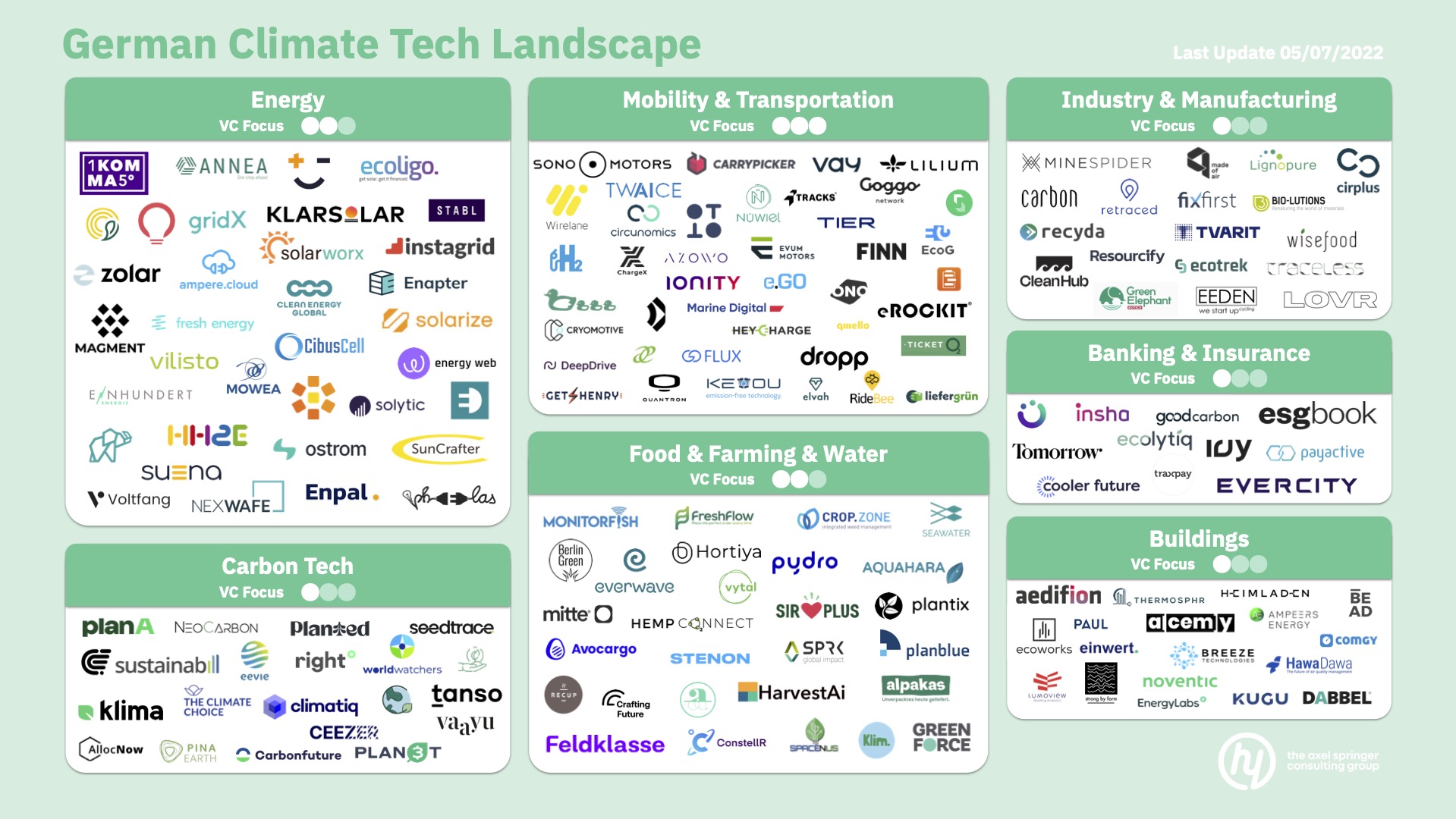
Climate Tech is currently the fastest growing vertical in Europe. In 2021 alone, European startups raised more than USD 11 billion in venture capital – an increase of more than 2.2 times compared to 2020 (Dealroom). Climate Tech includes business models and technologies that aim to reduce global greenhouse gas emissions and thus decarbonize the global economy, and covers the areas of buildings and mobility to food and farming. More and more climate tech startups are valued in the billions: more than 10% of the more than 50 climate tech unicorns worldwide come from Germany (including Enpal, TIER Mobility, Lilium, INFARM, Sunfire GmbH and Volocopter GmbH).
Together with my colleagues Pia Sander and Jil Zoé Fuhrmann, we’ve put together a climate tech map for Germany. A total of more than 170 companies that meet the following criteria have made it onto our German Climate Tech Map:
The company is active in the Climate Tech area in the areas of Banking & Insurance, Buildings, Carbon Tech, Energy, Food & Land & Water, Industry & Manufacturing or Mobility & Transportation.
The company’s headquarters are in Germany.
The company was founded in 2015 or later.
The company has funding (equity/debt).
More than 25% of startups are in the mobility & transportation sector, closely followed by energy startups (20%). In the future we will probably see even more start-ups in the Carbon Tech sector – this group currently accounts for around 13%.
Here is the complete list with all German climate tech startups. Did we forget a startup? Then please leave a comment!
Should you make the first offer in a negotiation, or wait for the other side to reveal their expectations?
There are reasonable arguments for both approaches. Moving first allows you to influence the starting point of the discussion. Waiting may provide valuable information and protect you from proposing something the other party would have been happy to improve upon. The difficulty is knowing which consideration should guide your decision.
In our article, “Toward a Process model of First Offers and Anchoring in Negotiations,” co-authored with Wolfram Lipp and Peter Kesting and published in Negotiation and Conflict Management Research, we examined 119 journal articles to bring these perspectives together.
The evidence confirms that first offers have a powerful influence on negotiation outcomes. Understanding how to use them, however, requires looking at the entire interaction they set in motion.
Why first offers matter
First offers often create an anchoring effect. Once a proposal has been introduced, it becomes a reference point that influences the recipient’s expectations, counteroffer, and assessment of possible agreements.
Imagine discussing a consulting contract. An opening proposal of €30,000 is likely to create a different conversation from one beginning at €15,000, even when the underlying assignment is identical. The recipient may reject either proposal, yet still adjust their counteroffer around the number placed on the table.
One explanation is that people adjust insufficiently from an initial value. Another is that an anchor directs attention toward information consistent with it. A high opening price may encourage the buyer to consider reasons why the service could be particularly valuable.
This helps explain why rejecting an offer does not necessarily eliminate its influence. You can disagree with a number while allowing it to shape your thinking.
A first offer can contain much more than a number
In the article, we define a first offer as the first settlement proposal made by either negotiating party. This includes proposals concerning qualitative terms.
An employment offer may combine salary with responsibilities, flexibility, and development opportunities. A partnership proposal may establish how decisions will be made or how responsibilities will be divided. These elements can structure the negotiation even when they do not have an immediately visible monetary value.
We also distinguish first offers from anchoring. The offer is a proposal; anchoring is a psychological mechanism that may help explain its effects. Other reference points, including previous agreements or a negotiator’s own aspirations, can also act as anchors. This distinction matters because an opening proposal communicates information as well as establishing a reference point.
Understanding the process behind the first-offer effect
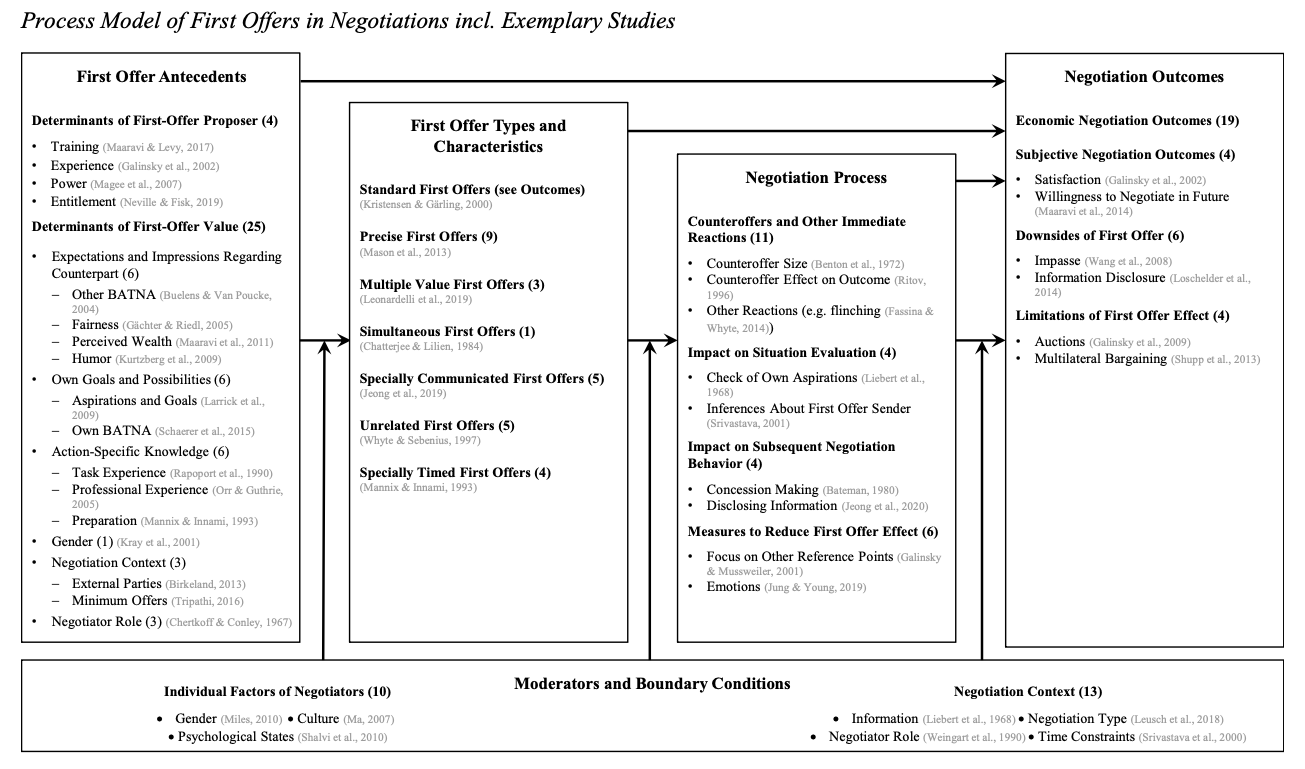
Our model connects four elements: the factors shaping the first offer, the offer’s characteristics, the subsequent negotiation process, and the outcomes. Individual and contextual conditions influence how these elements interact.
Process Model of First Offers in Negotiations incl. Exemplary Studies
Before an offer is made, negotiators already have expectations about the counterpart, their own objectives, and the alternatives available. These considerations help determine who opens and what they propose.
The offer’s value, precision, framing, and timing then influence how it is received. The counterpart responds, interprets what the proposal reveals, and adjusts their behavior. Counteroffers, concessions, and information exchange carry the negotiation forward.
Eventually, this interaction produces economic and subjective outcomes, potentially including an impasse.
The model therefore directs attention to what happens between the opening proposal and the final agreement. This is also where our review identifies some of the largest gaps in the evidence.
How you make the offer matters
Several findings show why opening strategy cannot be reduced to choosing an ambitious number. Precise offers can make a negotiator appear better informed. A proposal of €28,750 may suggest a more considered calculation than €30,000. However, excessive precision can lose credibility with knowledgeable counterparts, and precision may also signal inflexibility. The implication is to use a level of precision that you can explain convincingly.
Another approach is to present several packages that are equally valuable to you but combine the issues differently. For example, a service provider might offer a higher fee with greater flexibility or a lower fee with a longer commitment. Research reviewed in our article suggests that multiple equivalent simultaneous offers can improve individual outcomes, joint value, and the relationship.
Explanations also require judgment. Adding an argument does not automatically strengthen an offer. When the recipient can easily generate counterarguments, the explanation may invite resistance and weaken the outcome.
These findings encourage negotiators to consider what the offer allows the other side to infer about their competence, intentions, and willingness to explore alternatives.
When moving first can become a disadvantage
The first-offer advantage has important limits. An extreme proposal can provoke offense, increase the likelihood of impasse, or reduce the counterpart’s willingness to negotiate again. An opening that produces a favorable price among completed deals may still be unattractive if it also causes valuable agreements to collapse.
Information asymmetry creates another difficulty. If you know very little about an unfamiliar item’s value, your opening may reflect a mistaken assumption. Waiting can sometimes be beneficial because it allows the better-informed party to reveal a starting point.
In negotiations involving several issues, an opening may also disclose priorities that a self-interested counterpart can exploit. Sharing information remains essential for discovering mutually beneficial trade-offs, but negotiators need to consider what they reveal and whether the exchange is reciprocal.
The review supports taking first offers seriously. It does not establish a universal rule to move first regardless of preparation, information, or context.
What if the other party opens?
Receiving the first offer does not remove your ability to influence the negotiation. The reviewed evidence suggests that focusing on information inconsistent with the anchor can reduce its effect. Relevant reference points include your own target, the counterpart’s alternatives, and their likely reservation value, the threshold beyond which an agreement becomes unattractive to them.
A practical implication is to prepare these reference points before the conversation. Otherwise, the other party’s opening may become the most readily available basis for your response.
Consider a supplier requesting a substantial price increase. Before deciding how far to move toward that request, you might examine competing quotations, changes in the scope of supply, and the commercial alternatives available to both sides. These are illustrative ways to assess the proposal against independent information.
Preparation cannot guarantee immunity from anchoring. It can provide a stronger foundation for evaluating an offer and developing your counterproposal.
A good price is only part of the outcome
First offers also influence how negotiators feel about the agreement and each other. An especially revealing finding concerns immediate acceptance. Negotiators whose first offer is accepted straight away may feel less satisfied, even when their economic outcome is favorable. They begin wondering whether they could have obtained more.
Other studies connect aggressive anchoring with lower counterpart satisfaction and reduced interest in future negotiations. Such consequences deserve particular attention when parties expect to work together again.
Our review therefore considers economic outcomes alongside subjective outcomes and the risk of impasse. The appropriate opening strategy depends partly on which of these consequences matters in the relationship.
What we still need to understand
Although the connection between first offers and outcomes is well established, the research offers less certainty about the interaction that produces those outcomes.
How does the initial response change the direction of the negotiation? When does an ambitious opening become counterproductive? How do qualitative proposals shape later discussion? What happens when the same parties negotiate repeatedly?
Our central argument is that research needs to examine the opening as an exchange between interdependent parties. The first proposal matters, but so do the response and the behavior that follows.
For practitioners, this suggests preparing an opening strategy with several questions in mind:
What information supports my proposal?
What does it reveal about my priorities?
How might the counterpart interpret and respond to it?
Which reference points will guide me if they open first?
What consequences could this opening have for future cooperation?
A well-prepared first offer gives direction to the discussion while leaving room to learn from the other side. Its value ultimately depends on the negotiation it helps produce.