Negotiation requires us to understand other people’s interests, recognize emotions, listen carefully, manage conflict, build relationships, and find solutions when interests do not fully align. These are also central elements of effective leadership.
But surprisingly, there is relatively little empirical evidence showing that studying negotiation actually contributes to the development of leadership-related capabilities.
Our new paper, “Studying negotiation makes leaders: an empirical study on the impact of negotiation training on self-perceived emotional intelligence and leadership potential,” published in the International Journal of Conflict Management, takes a closer look at this relationship.
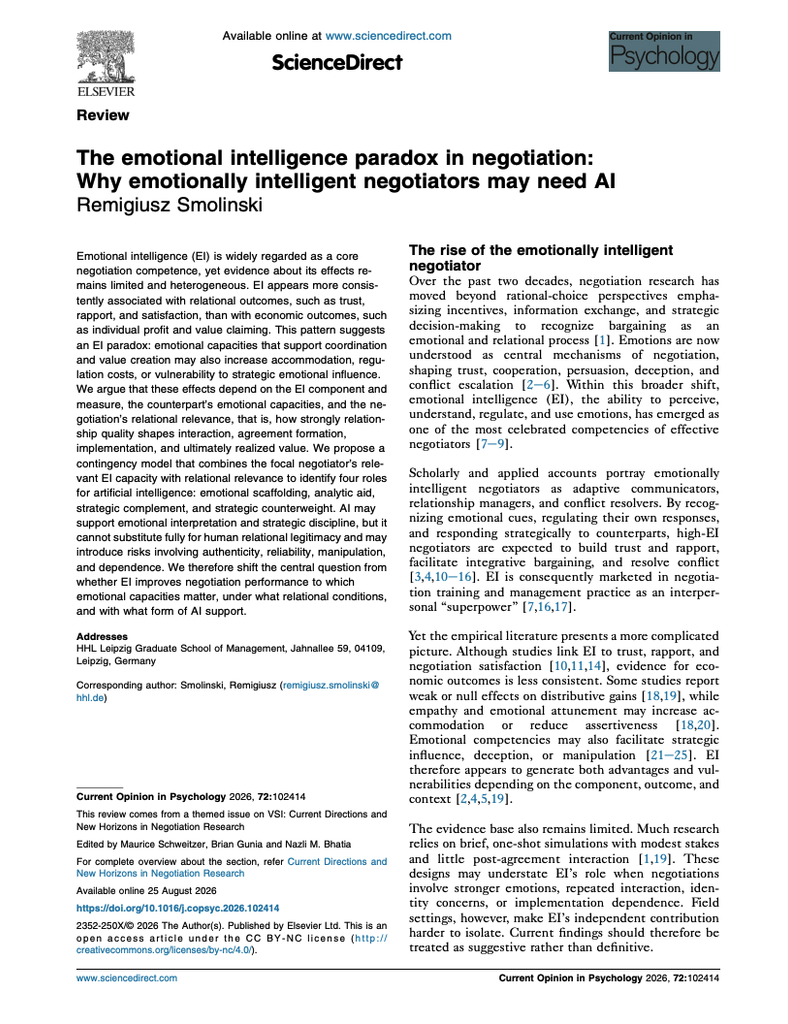
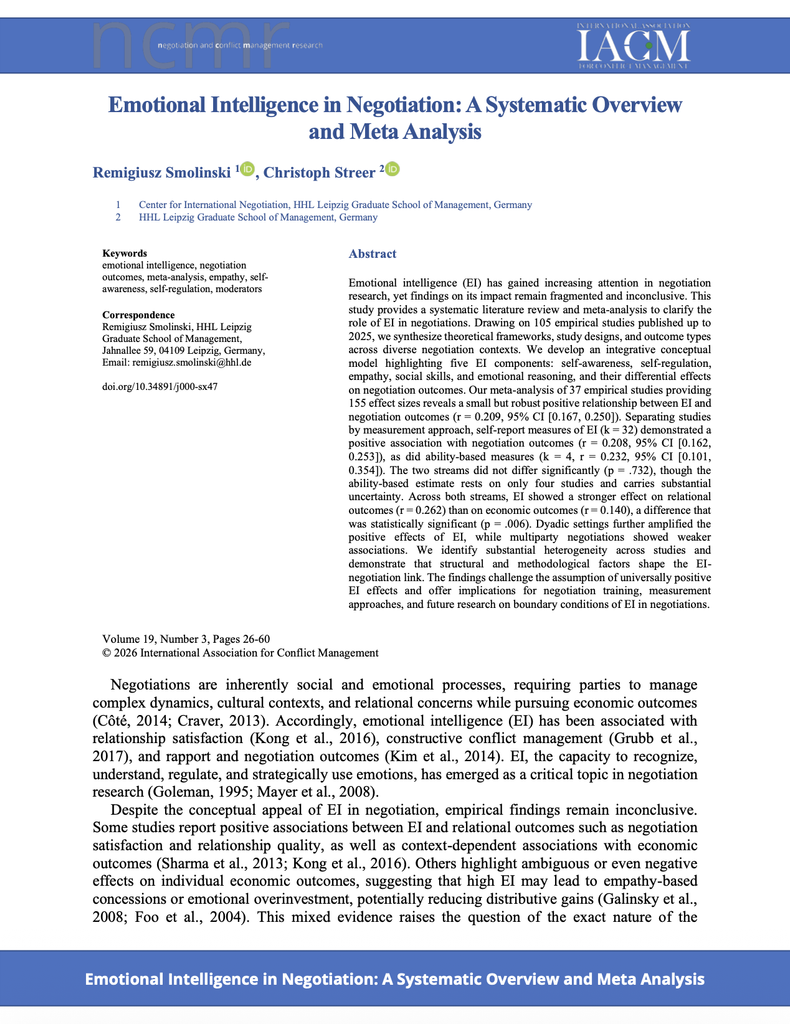
Much of the existing research has approached the relationship between emotional intelligence and negotiation from one direction: emotionally intelligent people should be better negotiators. They tend to be more capable of recognizing emotions, regulating their own reactions, understanding their counterparts, and managing relationships. Our own previous work also found a positive, although context-dependent, relationship between emotional intelligence and negotiation outcomes.
In this study, however, we turned the question around. What if negotiation does not only benefit from emotional intelligence, but studying negotiation can also help develop it?
Negotiation as training in human interaction
Students repeatedly practice putting themselves in another person’s position, identifying interests, dealing with different perceptions, managing emotions, listening actively, communicating effectively, and building relationships. They encounter disagreement and resistance and have to find ways of moving forward without simply relying on authority. These are negotiation competencies, but they are also very closely related to leadership.
This was the basic idea behind our study. Over four years, we followed graduate students at LUISS University in Rome. One group participated in the NegotiatingLab, an experiential negotiation course combining theory and extensive role-playing. A comparison group consisted of students from the same MSc program who attended another course unrelated to negotiation.
We measured changes between the beginning and the end of the courses in four components of self-perceived emotional intelligence: self-awareness, self-management, social awareness, and relationship management, as well as two leadership-related capabilities: participative decision making and coaching.
The results are encouraging. Students participating in the negotiation course reported a significant increase in overall self-perceived emotional intelligence of 4.3% and in leadership-related skills of 5.2%. In the comparison group, emotional intelligence changed by only 0.4%, while leadership skills remained essentially unchanged. The changes in the comparison group were not statistically significant.
The pattern also appeared across the individual dimensions. Students in the negotiation course reported improvements in self-awareness, self-management, social awareness, relationship management, participative decision making, and coaching.
Leadership is a negotiation process
These findings are interesting because they speak to a broader understanding of leadership. Leadership is often associated with formal authority, vision, charisma, or the ability to make decisions. But leadership is fundamentally relational. Leaders have to bring people along whose interests, preferences, and perceptions may differ from their own and from those of the organization.
A title may give someone formal authority. It does not automatically make others want to follow. Leaders therefore constantly have to negotiate: about direction, priorities, resources, responsibilities, change, conflict, and the balance between individual and collective interests.
This argument is not new. Jeswald Salacuse, among others, has long described leadership as a process deeply rooted in negotiation. What our study adds is preliminary empirical evidence suggesting that the relationship may also have developmental consequences: studying negotiation may strengthen capabilities that people associate with effective leadership.
There is also a useful way of thinking about what happens in a negotiation classroom. Negotiation training may function as structured practice in human interaction. Students repeatedly experience situations in which the other person does not see the world the way they do. Their assumptions are challenged. Their arguments sometimes fail. Emotions appear. Misunderstandings emerge. Relationships matter. They discover that asking the right question can be more effective than making another argument and that understanding another person’s interests can completely change the structure of a problem.
And then they do it again in the next simulation. This repeated cycle of interaction, feedback, and reflection may explain why negotiation education can reach beyond bargaining itself. In our paper, we argue that it may provide repeated opportunities to practice perspective-taking, emotion regulation, active listening, and interest-based interaction. All capabilities that are highly relevant for leadership.
An important caveat
The results should, however, not be overstated. The study relies on self-reported measures, the students were not randomly assigned to the courses, and the experimental sample was relatively small. We therefore cannot conclude that taking a negotiation course automatically makes someone a better leader.
It is also possible that negotiation education partly changes how students perceive these competencies. After spending a semester discussing emotions, relationships, interests, listening, and conflict, participants may become more aware of these dimensions and of their own ability to deal with them.
Future research should therefore replicate the study with larger samples, behavioral measures, peer assessments, and ideally randomized designs.
Still, the results raise an interesting question about how we think about negotiation education. We typically teach negotiation because people negotiate contracts, salaries, partnerships, resources, or business deals.
But perhaps this is too narrow. Negotiation is one of the few areas of management education in which students repeatedly practice dealing with another human being whose interests differ from their own. They have to listen, adapt, regulate themselves, understand the other side, build trust, handle disagreement, and still pursue their own objectives.
That makes negotiation training relevant far beyond the negotiation table. It may also be one of the ways in which we develop future leaders.
The full paper:
Monoriti, A., Lombardi, S., Di Luzio, L., Fabozzi, R., Giustiniano, L., & Smolinski, R. (2026). “Studying negotiation makes leaders: an empirical study on the impact of negotiation training on self-perceived emotional intelligence and leadership potential.” International Journal of Conflict Management.