How Much Is Enough? Sufficiency and the Limits of Maximization in Negotiation

Much of negotiation theory and practice is organized around a simple idea: better negotiators achieve better outcomes, and better outcomes usually mean more. We encourage negotiators to set ambitious targets, make strong first offers, create as much value as possible, and claim a substantial share of it. When value remains on the table, we tend to interpret it as evidence of poor preparation, limited skill, cognitive bias, or strategic failure.

These ideas have transformed negotiation teaching and practice, and they remain enormously valuable. But they also rest on an assumption that is rarely questioned: if more value can still be obtained, a rational negotiator should continue pursuing it. Is that always true?

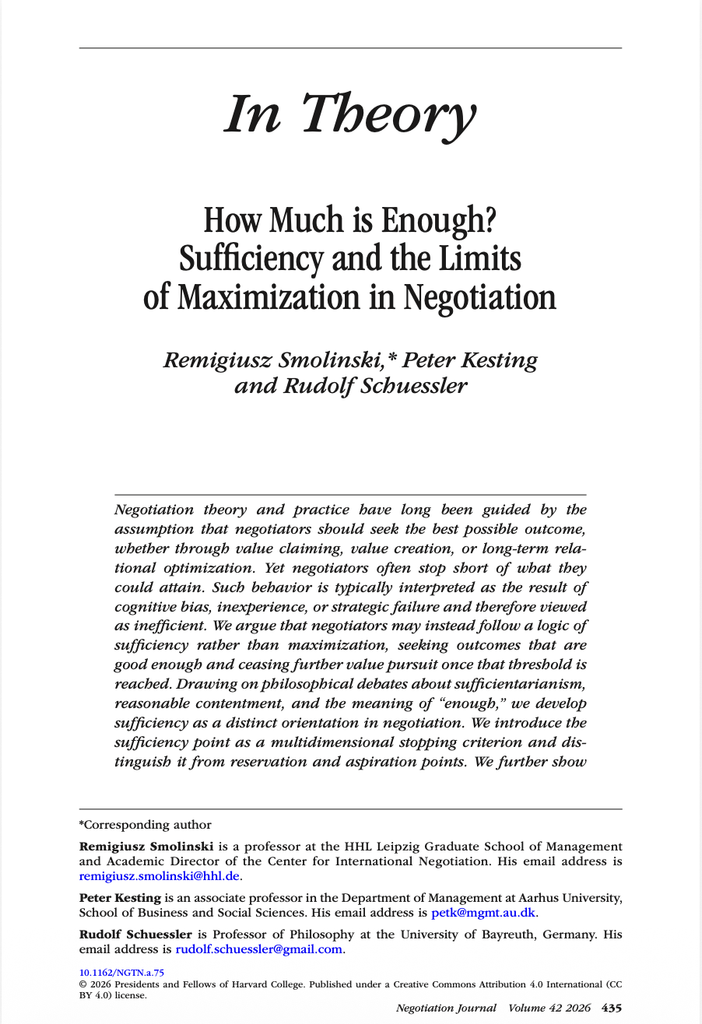
In our newly published article, “How Much Is Enough? Sufficiency and the Limits of Maximization in Negotiation,” co-authored with Peter Kesting and Rudolf Schüssler, we explore an alternative possibility. Negotiators may sometimes stop not because they are unable to obtain more, but because they have reached a point at which more is no longer necessary, proportionate, or worth pursuing. We call this the logic of sufficiency.
When “more” becomes the definition of success

The ideal of maximization is deeply embedded in the language of negotiation. In distributive negotiation, success means claiming the largest possible share of a fixed amount of value. In integrative negotiation, it means expanding the pie and reaching a Pareto-efficient agreement. Even in long-term relationships, the objective is often described as maximizing value over time.

The object being maximized may change, but the underlying logic remains the same: as long as an improvement is possible, stopping appears irrational.

Our article opens with an image from Robert Harris’s Imperium: Pompey the Great displaying a fish adorned with jewels, a symbol of abundance that has become detached from need, utility, or meaning. It captures what we describe as maximization without measure. More is pursued because it is more, rather than because it still serves a meaningful purpose.

Source: Wikipedia

Negotiation can follow the same logic. A negotiator may continue pressing for a lower price, an additional concession, or a slightly more favorable clause long after the resulting gain has ceased to matter. The agreement may look better on a spreadsheet, yet be worse when we consider the time consumed, the resentment created, the burden placed on implementation, or the effect on people who were not present at the table.

Maximization is therefore not self-justifying. Before asking whether more can be obtained, we may also need to ask what that additional value is for.

The sufficiency point

At the center of our argument is the concept of a sufficiency point: the point at which a negotiator judges that an outcome adequately fulfills their legitimate objectives and that further gains are no longer necessary or worth pursuing.

Negotiators are already taught to prepare two important reference points: the reservation point marks the boundary below which an agreement should be rejected and the aspiration point represents the ambitious outcome the negotiator hopes to achieve. The sufficiency point answers a different question: At what point would the outcome genuinely be enough?
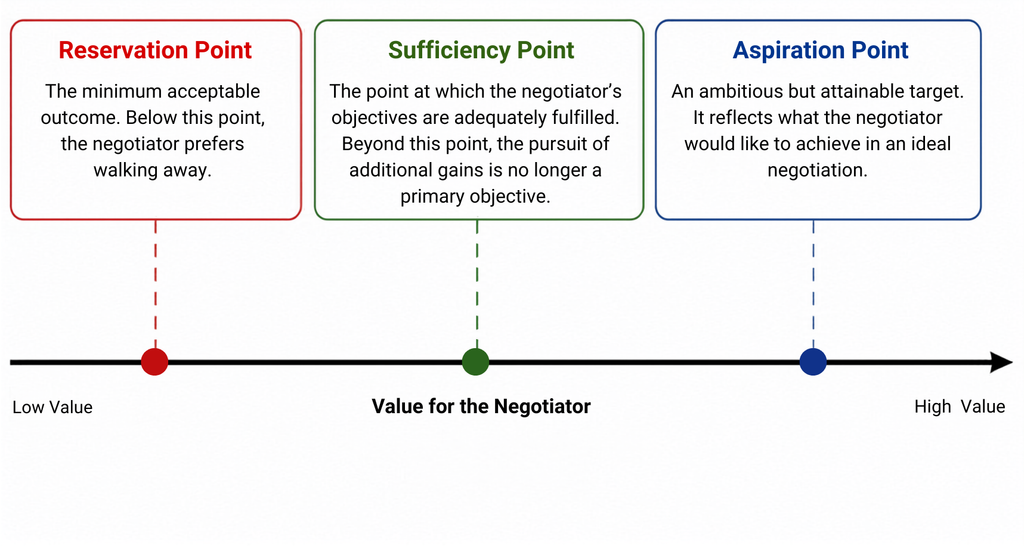
Source: Smolinski et al. (2026).

A reservation point and an aspiration point are usually expressed on the value scale of the negotiation: a price, salary, percentage, delivery date, or package score. Sufficiency is a higher-order judgment. It may include economic needs, but also fairness, relationships, moral commitments, stakeholder effects, implementation risks, sustainability, and the broader circumstances in which the agreement will operate.

The sufficiency point is therefore often multidimensional. A manager may regard an agreement as sufficient only if it protects the company’s economic interests, treats employees responsibly, preserves a strategically important supplier relationship, and remains defensible to shareholders. A salary package may be sufficient not because it contains the maximum available salary, but because it combines adequate pay with autonomy, meaningful work, reasonable demands, and long-term opportunity. In both cases, “enough” cannot be reduced to a single number.

Sufficiency is not satisficing

The idea of accepting an outcome that is “good enough” may sound similar to Herbert Simon’s concept of satisficing, but the distinction is important. Satisficing is primarily a response to bounded rationality. Because information, time, and cognitive capacity are limited, decision-makers stop searching once they encounter an acceptable option. Continuing the search might produce something better, but the expected improvement no longer justifies the additional effort or cost.

Sufficiency can lead to the same observable behavior: stopping before the maximum, but for a different reason. The negotiator may know that more value is available and may even be able to obtain it easily. They nevertheless decide not to pursue it because the present outcome is enough. This decision reflects a judgment about the value, purpose, and proportionality of further gain.

Sufficiency is not the same as compromise or splitting the difference. Compromise describes one way of resolving conflicting positions. Sufficiency is a stopping rule. It can support a distributive agreement, a compromise, or a highly creative integrative solution. What matters is not the form of the agreement, but why the negotiator decides that there is no need to keep extracting more.

When leaving value on the table is not a failure

Few expressions in negotiation carry as much criticism as “leaving value on the table.” It suggests that the negotiators failed to discover a trade-off, claimed too little, or settled prematurely. Sometimes that diagnosis is correct. Unexplored interests, weak preparation, or poor communication can certainly produce inferior agreements. But value left on the table is not always wasted value.

The film The Monk and the Gun provides a striking illustration. An American collector seeks to buy a rare rifle from a Bhutanese villager and is willing to pay far more than the villager ultimately accepts. From a conventional negotiation perspective, the villager has made a serious mistake. He could have claimed much more value and chose not to do so. From the perspective of sufficiency, however, the decision may be entirely coherent: the accepted amount was generous, adequate, and more appropriate to the villager’s understanding of what was needed.

Source: Wikipedia

The example is deliberately unsettling because it forces us to separate two questions that negotiation theory often treats as identical: Could the negotiator have obtained more? And should the negotiator have wanted more?

Residual value may also have uses beyond the focal negotiator. It may remain with employees, consumers, communities, suppliers, future partners, or society. A company that declines to extract every possible concession from a vulnerable supplier may preserve resilience and trust in its supply chain. A landlord who accepts a reasonable rent rather than the maximum the market will bear may help sustain a community. A party that refrains from exploiting temporary bargaining power may create the conditions for future cooperation.

Seen this way, apparent inefficiency can sometimes represent efficiency restraint: a deliberate decision not to exhaust every available gain because doing so would be unnecessary, disproportionate, or harmful when viewed through a broader frame.

Sufficiency can change the negotiation itself

Sufficiency may also change how negotiators behave before agreement is reached. If parties believe that every disclosed preference will be used to extract the maximum possible advantage, they have good reason to protect information and approach integrative moves with suspicion. By contrast, credible restraint may reduce fears of exploitation. It can make it safer to disclose interests, explore creative options, and build the trust on which value creation depends.

This does not mean that sufficiency automatically produces better relationships or more efficient agreements. Its effects are most likely conditional. A negotiator who encounters a fair and reasonable counterpart may be willing to stop once enough has been achieved. The same negotiator may respond very differently to someone who is aggressive, exploitative, or determined to capture every available gain. Sufficiency need not require unilateral generosity in the face of opportunism. Counterpart behavior can shift negotiators back toward maximization, just as deteriorating economic or security conditions can change what counts as enough. Sufficiency is therefore contextual and revisable.

Sufficiency is not an excuse to settle too early

There is an obvious danger in the language of “enough.” It could be used to rationalize poor preparation, weak ambition, avoidable concessions, or a premature agreement. It could also prevent parties from discovering integrative gains that would make everyone better off. That is not the argument we make.

Negotiators should still prepare carefully, understand their alternatives, set ambitious aspirations, exchange information, and search seriously for mutually beneficial trade-offs. Sufficiency should become relevant after genuine exploration, not serve as a reason to avoid it. Stopping before understanding what is possible may be complacency. Stopping after understanding what is possible can be judgment.

The distinction matters especially in integrative negotiation. Creating additional joint value is often beneficial because it need not come at the expense of either party. Yet even value creation has costs. Additional rounds of bargaining require time and attention; more complex packages can become difficult to understand and implement; and seemingly efficient options may shift costs to absent stakeholders. Pareto efficiency is valuable, but it is a form of rationality within a particular decision frame. It does not tell us whether that frame includes everything that ought to matter.

Preparing for enough

Therefore, the practical implication is that preparation should include another set of questions alongside the familiar analysis of interests, alternatives, and bargaining ranges:

  • What do I genuinely need this agreement to accomplish?
  • Which economic, relational, moral, or strategic objectives must it satisfy?
  • Who else will bear the consequences of the agreement?
  • At what point would additional gain cease to make a meaningful difference?
  • What might be damaged by continuing to press for more?
  • Under which circumstances should my judgment of “enough” change?

Answering these questions in advance can be difficult, but that is precisely why they belong in preparation. In the pressure of a negotiation, success is easily redefined by the next concession that might still be won. A sufficiency point provides a counterweight: not a rigid ceiling, but a reminder of the purposes the negotiation was meant to serve.

What this means for negotiation teaching

Negotiation education has become very good at teaching people how to get more. Students learn to diagnose the bargaining structure, calculate their alternatives, set ambitious targets, make and respond to offers, uncover interests, create value, and claim it effectively. These are essential competencies. But perhaps negotiation wisdom requires one more: knowing when further gain is no longer an improvement.

This changes the questions we ask when evaluating negotiation performance. Instead of looking only at how much value was created or claimed, we might also ask whether the outcome adequately met the parties’ legitimate objectives, whether further extraction would have served any meaningful purpose, and what consequences the agreement created outside the chosen scoring frame.

It also opens a broader research agenda. How do people form sufficiency points? How stable are they? How do power, culture, scarcity, identity, relationships, and counterpart behavior affect them? When does sufficiency support trust and sustainable cooperation, and when does it merely conceal low aspirations or unequal expectations? These are empirical questions, and we do not yet have all the answers.

A broader understanding of rationality

Our argument is not that maximization is wrong. In many negotiations, obtaining more is necessary, responsible, and entirely rational. Managers have obligations to their organizations and shareholders. Individuals may negotiate under conditions in which every additional resource matters. Innovation, exceptional performance, and ambitious social change often depend on refusing to settle for what currently appears sufficient. The problem begins when maximization stops being a means and becomes the unquestioned definition of success.

A negotiator who leaves value on the table may have miscalculated. But they may also have exercised restraint, protected a relationship, respected a moral commitment, accounted for stakeholders, or recognized that another increment of value would add little to a life, an organization, or a society that already has enough.

Rationality in negotiation should therefore involve more than choosing the best available outcome within a given frame. It should also involve judging whether the frame itself captures what matters. Negotiation expertise helps us obtain more. Negotiation wisdom may begin when we can explain why more is still worth having and recognize when it is not.

The full article is available here:

Smolinski, R., Kesting, P., & Schüssler, R. (2026). “How Much Is Enough? Sufficiency and the Limits of Maximization in Negotiation.” Negotiation Journal, 42, 435–457.

Source: How Much Is Enough? Sufficiency and the Limits of Maximization in Negotiation | Negotiation Journal
Beyond Rationality: Decision Drivers of Ethically Ambiguous Negotiation Tactics

Negotiation is often described as a rational process. People enter a negotiation with goals, alternatives, interests, and constraints. They evaluate options, compare possible outcomes, and decide how far they are willing to go to reach an agreement.

When ethically questionable behavior occurs in negotiation, the explanation often follows the same logic: a negotiator weighs the potential benefits of a tactic against the possible costs and then decides whether it is worth the risk.

That explanation is intuitive. It is also incomplete.

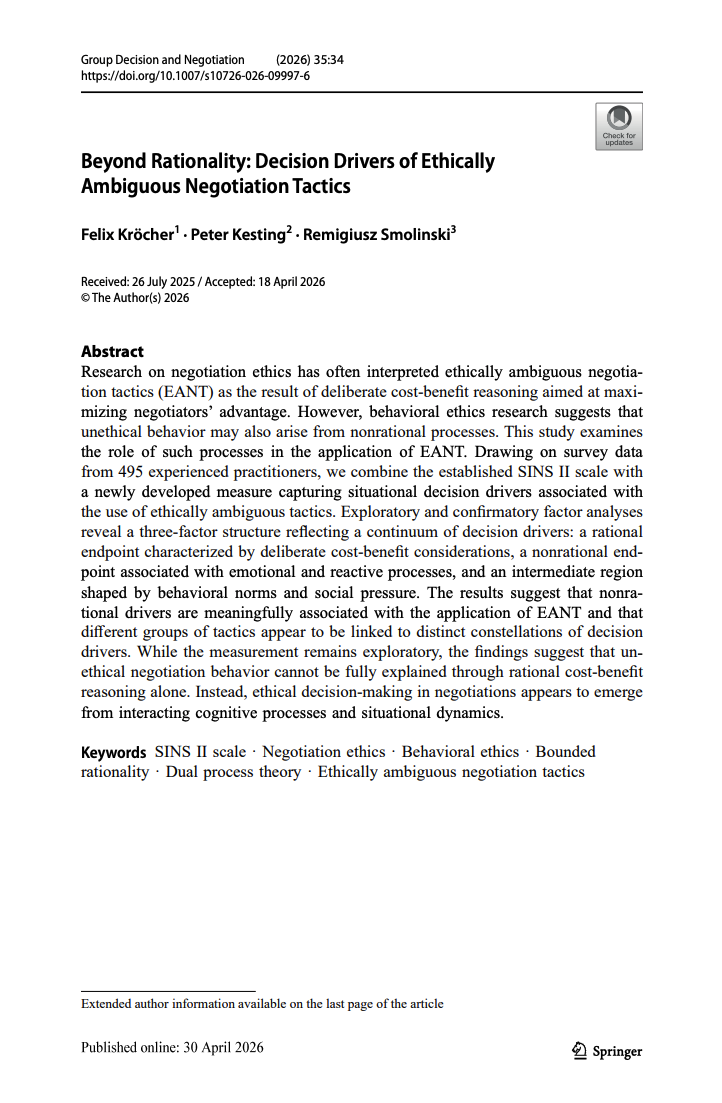
Our article, “Beyond Rationality: Decision Drivers of Ethically Ambiguous Negotiation Tactics,” now published open access in Group Decision and Negotiation, examines what drives negotiators to use tactics that fall into an ethical gray area. The article was co-authored with Felix Kröcher and Peter Kesting, and it explores a question that has stayed with us for a long time: when negotiators use ethically ambiguous tactics, what is actually behind that behavior?

Ethics in negotiation is rarely simple

Negotiation often involves tension. Parties want to create value, but they also want to claim value. They want to build trust, but they may also feel pressure to protect themselves. They want to be honest, but they may not always feel obliged to disclose everything.

This creates a space in which certain tactics can appear tempting: exaggerating one’s alternatives, withholding relevant information, applying pressure, misrepresenting priorities, or exploiting the other side’s assumptions.

Some of these tactics may be clearly unethical. Others are ethically ambiguous. They may be seen by some negotiators as part of the game, while others experience them as manipulative or dishonest. In many negotiations, ethical decisions do not present themselves as obvious choices between right and wrong. Instead, they emerge in situations marked by uncertainty, pressure, emotion, competition, and social expectations.

The limits of the rational cost-benefit view

A common explanation for ethically questionable negotiation behavior is that negotiators make a deliberate trade-off. They consider the possible advantages of a tactic, such as gaining better terms, increasing leverage, or avoiding a concession. They also consider the possible downsides, such as reputational damage, retaliation, guilt, legal consequences, or the breakdown of trust.

From this perspective, unethical or ethically ambiguous behavior is mainly a matter of calculation.

Our findings suggest that this view is too narrow.

Based on survey data from nearly 500 experienced practitioners, we show that the use of ethically ambiguous negotiation tactics is linked not only to rational cost-benefit considerations, but also to a broader set of decision drivers. These include emotional, reactive, normative, and socially shaped factors.

In other words, ethically questionable behavior in negotiation is not always a cold calculation. Sometimes it is fast, intuitive, situational, and only partly deliberate.

Negotiators do not always act after careful reflection

This matters because much of the advice around ethical negotiation assumes that people make ethical choices through conscious reasoning. We tell negotiators that ethical behavior pays off in the long run. We explain that trust is valuable, that reputations matter, and that manipulative behavior can damage future relationships.

Those arguments are important. But they may not be enough.

In practice, negotiators may act under time pressure. They may respond defensively to a perceived threat. They may mirror the behavior of the other side. They may feel that “everyone does this.” They may be influenced by organizational norms, competitive incentives, or the behavior of senior colleagues. They may experience anger, fear, frustration, or anxiety and then justify their behavior afterward.

This means that ethical behavior in negotiation is not only a matter of knowing what is right. It is also a matter of recognizing what is happening in the moment.

Ethical negotiation requires more than good intentions

For those of us who teach, train, or advise negotiators, this has practical implications.

Encouraging ethical negotiation cannot rely only on explaining why ethics is beneficial in the long run. That message remains valuable, but it may miss the situations in which people act before they fully reflect.

A more effective approach should help negotiators develop awareness of the triggers that can pull them toward ethically ambiguous behavior. These triggers may include:

  • feeling treated unfairly by the other side;
  • pressure to achieve a specific outcome;
  • fear of appearing weak;
  • competitive organizational cultures;
  • ambiguity about what is acceptable;
  • emotional escalation during difficult conversations;
  • social norms that frame questionable tactics as “just business.”

Once negotiators can recognize these dynamics, they are better positioned to pause, reassess, and choose a different response.

Building ethical capacity in the moment

One of the key lessons from our research is that ethical negotiation should be understood as a capability, not simply as a principle.

It is not enough to tell negotiators to “be ethical.” They also need tools that help them behave ethically when the situation becomes difficult.

That may include preparing ethical boundaries before entering a negotiation, discussing acceptable and unacceptable tactics within teams, reflecting on emotional triggers, creating space for deliberate decision-making, and developing strategies for responding when the other side uses questionable tactics.

Ethics also needs to be addressed at the organizational level. If negotiators are rewarded only for short-term outcomes, while the methods used to achieve those outcomes are ignored, ethically ambiguous behavior becomes more likely. Training individuals is important, but so is shaping the norms, incentives, and expectations around negotiation.

Why this research matters

Negotiation is central to business, politics, employment relationships, procurement, conflict resolution, and many other areas of professional life. The quality of negotiation behavior affects not only the outcomes of individual deals, but also trust, relationships, and institutional credibility.

Our study contributes to a better understanding of why negotiators sometimes use ethically ambiguous tactics. It moves beyond the idea that such behavior is always the result of deliberate calculation and shows that ethical decision-making in negotiation is shaped by a wider range of psychological and social forces.

Recognizing this complexity does not excuse unethical behavior. It does help us understand it better. And if we understand it better, we can design better training, better organizational practices, and better negotiation processes.

Many thanks to the reviewers and editors at Group Decision and Negotiation for a constructive and helpful review process. The paper is much stronger because of their input.

Source: Beyond Rationality: Decision Drivers of Ethically Ambiguous Negotiation Tactics | Group Decision and Negotiation | Springer Nature Link

What Makes a Great Negotiator, According to Research

For nearly 20 years, Peter Kesting and I have observed thousands of negotiations conducted by some of the brightest negotiators on the planet. We’re thrilled that our findings are now out in Harvard Business Review in an article titled “What Makes a Great Negotiator, According to Research.” This post shares the core ideas behind the piece plus a few personal reflections on why they matter for leaders, teams, and organizations.

Our research draws on almost 1,000 documented negotiations from The Negotiation Challenge (TNC), a global competition we’ve run for years with meticulously designed scenarios, structured scoring, and expert judging. Each negotiation produces both substantive outcomes (what was achieved) and relational outcomes (trust, credibility, working climate). This dual lens lets us test a long-standing assumption in our field.

The traditional view says negotiators must choose: push hard for results or play it soft to preserve the relationship. Our data doesn’t support that. The best negotiators consistently achieve both strong outcomes and trust. In other words: great negotiation isn’t about temperament; it’s about competence.

We saw top performers who were quiet and reflective; others were energetic and highly expressive. Style varied widely. What didn’t vary among the best was skill—the ability to read the room, manage emotion, frame issues clearly, and sequence moves that create value while safeguarding credibility.

Great negotiators balance assertiveness with empathy, knowing when to compete, when to cooperate, and how to blend both without losing trust. They stay flexible, adapting strategy as new information emerges rather than clinging to a script. They make their thinking visible by structuring the conversation, naming issues, surfacing interests, and proposing options so progress is trackable. Throughout, they protect the relationship while creating value, separating people from problems without separating people from respect.

Across cases, four higher-order competencies predicted excellence:

  • Language and Emotionality – Clear framing, precise language, and emotional self-regulation. These negotiators can put complex issues into simple words and keep the temperature of the conversation productive.
  • Negotiation Intelligence – Strategic sense-making: diagnosing the situation, mapping interests, and choosing tactics that fit the context. It’s the ability to combine analysis with timing.
  • Relationship Building – Trust is not an afterthought. Top performers invest in credibility, follow-through, and psychological safety—because those are the preconditions for creating value.
  • Moral Wisdom – Empathy-guided ethical clarity and fairness instincts; these negotiators protect long-term reputation and avoid short-term wins that poison future cooperation.

Even among exceptionally capable participants, only about 5% consistently achieved both strong substantive and relational outcomes. “Integrated achievers” are rare—and that rarity is instructive. Excellence is not a personality trait; it’s the result of deliberate practice, feedback, and measurement.

Measurement matters! If we don’t assess how we negotiate, as individuals, teams, and organizations, we limit learning and progress. Use clear rubrics to define what “good” looks like, combine metrics that capture both results and relationships, and track performance repeatedly over time rather than relying on one-off scores.

For leaders and their organizations, the evidence suggests treating negotiation as a core leadership discipline, one that can be measured, taught, and improved. It may be valuable to invest in capability building around the four meta-competencies and to emphasize structured, feedback-driven practice. Incentives could be aligned to recognize outcomes that create value and sustain relationships, and it can be helpful to cultivate a “data habit” by regularly capturing negotiation performance across projects, suppliers, and internal talks to inform coaching and continuous improvement.

Writing the HBR piece reminded me how persistent the false binary remains: “win the deal” versus “protect the relationship.” Our evidence shows you can do both and the best do. It also reinforced how rare integrated excellence is. That rarity, however, is an invitation: with the right practice and measurement, more negotiators can join that 5%. Finally, the work reaffirmed a simple truth: progress requires feedback. Without structured assessment, we’re left with anecdotes and overconfidence.

This project would not exist without the vibrant community around The Negotiation Challenge: the participants who put their skills to the test, the judges who generously share their expertise, and the scholars and practitioners who have debated, challenged, and refined these ideas with us over the years.

Thank you!

Source: What Makes a Great Negotiator, According to Research

N-Conferance X Forbes: ,,The Art and Science of Negotiation” with Remi Smolinski 

A short summary of our research on negotiation performance recorded at the N-Conference 2024 in Zurich.

Part 1

Part 2

More about negotiation performance can be found in our paper that introduces the Negotiation Competency Model: Smolinski, R. and Xiong, Y.; In Search of Master Negotiators: A Negotiation Competency Model. Negotiation Journal 2020; 36 (3): 365–388. doi: https://doi.org/10.1111/nejo.12332.

Sustainability and Socially Responsible Negotiation

We kindly invite scholars to submit their original work to the Sustainability and Negotiation Special Issue hosted by the Negotiation Journal.

Call for Papers

Special Issue of the Negotiation Journal

SUSTAINABILITY AND SOCIALLY RESPONSIBLE NEGOTIATION

Are negotiation theory, practice, and pedagogy up to the task of ensuring that all negotiations: public and private, and whether or not explicitly focused on an issue of sustainability, address sustainability in socially responsible ways? This special issue invites original and rigorous scholarship that addresses whether and how our contemporary frameworks for interest-based negotiations can, do, or should take broader societal interests into account.

Overview

Sustainability, defined as fulfilling present needs without compromising the ability to meet future needs, is a crucial topic in contemporary research and discourse. Since 2020, over a million publications on sustainability have been indexed by Google Scholar, reflecting its growing prominence.

Negotiation can play a critical role in advancing sustainability goals. Well-designed processes can help to foster collaboration, reconcile diverse interests, and open creative space to address complex environmental, social, and economic challenges. This is perhaps most visible in the context of long, multi-stakeholder negotiations seeking progress on sustainability issues. But it also occurs in simpler, bilateral negotiations when social responsibility and sustainability are criteria for wise and just decision making.

This positive role for negotiation in sustainability emerged from a shift in theory, conceptualized by Mary Parker Follett a century ago and then revitalized most prominently by Fisher et al. (1982), that emphasized joint problem-solving over positional bargaining. This interest-based approach, which seeks efficient outcomes that satisfy all parties’ preferences and needs, has shaped the contemporary field of negotiation.

However, the emerging consensus that all actors share social responsibility for sustainability outcomes introduces new challenges for negotiation theory, practice, and pedagogy. Conventional approaches prioritize the interests of those at the table, and thus may overlook broader impacts on third parties, future generations, or the environment. Agreements that emerge may inadvertently perpetuate social and environmental harm, neglect historical injustices, or reinforce imbalances of power and oppression, for example, racism, sexism, or structural violence, even while meeting the articulated interests of the parties to that agreement.

These issues raise fundamental questions about how to ensure all stakeholders’ interests, including those not at the table, are integrated into negotiations. To achieve truly sustainable outcomes, negotiation processes must account for long-term impacts on a broad array of affected groups and societal interests.

This call builds from the proposition that such socially responsible negotiations that dependably consider and effectively address sustainability interests may well require new theory, frameworks, mechanisms, and approaches. These may need to address diverse perspectives on social responsibility; systemic inequalities; how to avoid reproducing historical injustices; or how to incorporate social value into even private negotiations. Additionally, insight is required on how to manage the friction and transaction costs that may accrue as parties pursue more inclusive and socially responsible agreements in a shift from optimizing private value to optimizing broader social value.

Scope and Objectives

This special issue of the Negotiation Journal seeks to explore these complexities at the intersection between sustainability and negotiation. At this intersection sit negotiations directly about sustainability, such as those over climate risk mitigation or advancement of the Sustainable Development Goals. But in a socially responsible world, so do negotiations on other matters, for example, commercial or financial transactions, governmental or inter-governmental policy making, or political mobilization and institutional change, even though sustainability may not be explicitly recognized or articulated as an interest by the parties.  

Thus, submissions should offer new perspectives on whether and how sustainability interests, whether environmental, social, political, economic, or cultural, are or can be addressed in both public and private negotiations, even when sustainability is not the explicit focus.

We invite scholarly work that draws on diverse disciplines, such as environmental studies, political science, economics, sociology, psychology, or law. Interdisciplinary perspectives that bridge these or other academic inquiries to negotiation frameworks are especially welcome. Contributions may be conceptual, theoretical, empirical, or pedagogical.

Contributions must be intellectually rigorous, linking to existing scholarship or identifying and bridging gaps to build the intellectual capital of the negotiation field. They must also provide practical insights for negotiation scholarship, practice, or pedagogy.

Potential Topics

We encourage submissions on a wide range of topics related to sustainability and negotiation, illuminating both the strengths of dominant paradigms as well as more critical perspectives. Potential topics include (but are not limited to) the following:

  • Scholars have shown the adaptability of the construct of interests by stretching it to include, for example, emotions, identity, justice, inclusion, basic human rights, or the shadow of the past. What are the consequences: positive or negative, intentional or not, of this broad view of interests? What might be alternative framings of what is and is not the subject of negotiations at the table? Where might there be useful extensions to negotiation scholarship with respect to interests?
  • Some sustainability issues, whether protection of the environment, worker health and safety, or indigenous rights, have been effectively enough socialized that they are broadly seen as interests to be considered even in private negotiations. What are the processes and dynamics which determine whether and how interests are considered or excluded from consideration in negotiations? The extent to which recognized interests are respected and advanced in practice?
  • Some scholars have asserted that the interest-based negotiations can be a power balancing tool, focusing parties on forward looking problem solving rather than on what they demand others do. Other scholars point out how negotiations outside the shadow of the law, in the context of oppressive laws, or where there are distinct inequalities can constitute a form of structural violence that legitimizes the taking of the lion’s share. How do we better understand and address the dilemmas inherent in this debate?
  • Negotiation scholarship intersects with other disciplines in demonstrating the superior value that can be created through the inclusion of diverse voices and perspectives. Yet representativeness of a broad range of perspectives and representation of potentially conflicting constituencies pose practical challenges. There are also challenges of unit of analysis, for example, between the strategic goals of individuals at the table vs the well-being of the community. How do we better conceptualize and operationalize how interests are given voice in negotiations? How are friction costs and transaction costs are managed?
  • Diverse domains, such as stakeholder theory, organizational behavior, peace and conflict studies, ethics, social psychology, political economy, and others, speak to how social, environmental, cultural, political, and economic sustainability are or are not conceptualized and operationalized at interpersonal, organizational, inter-organizational, and societal levels. Where might negotiation studies have blind spots that may be addressed through attentiveness to well-grounded propositions from related scholarship?

The overarching goal is to build towards a more comprehensive framework for negotiation theory, research, practice, and pedagogy that addresses the social responsibility of negotiators for sustainability interests.

Guest Editors

For further inquiries, please contact any member of the guest editorial team.

Submission Guidelines

We anticipate one or more paper development workshops on the topic of the Special Issue. One is already scheduled for the at INTRA Conference at the University of Cape Town in February 2025. Others will be announced. Participation in a PDW is neither a requirement for submission nor any guarantee of special consideration for inclusion. Rather, we hope that you will join like-minded scholars in a process of collegial reflection and constructive feedback that will inevitably shape stronger papers.

Authors should submit their manuscripts through the Negotiation Journal’s online submission system. Please ensure that your submission adheres to the Journal’s formatting and style guidelines.

We eagerly anticipate your submissions and the opportunity to advance the dialogue on sustainability and socially responsible negotiation.

Timeline

  • Call for Papers issued – September 2024
  • Submission of abstracts for the paper development workshop at INTRA Conference at the University of Cape Town – February 2025
  • Paper development workshop at INTRA Conference – April 24, 2025
  • Paper development workshop at the European Negotiation Conference – June 5-6, 2025
  • Paper development workshop at AOM Meeting – July 25-29, 2025
  • Paper submission deadline – September 30, 2025
  • Peer review process – October-December 2025
  • Decision notification – December 2025

The Path to Negotiation Mastery: Training, Practice, and Competitions

Historically, companies have relied on a combination of on-the-job training and workshops with internal or external trainers to develop their employees’ negotiation skills. While these methods offer valuable hands-on experience and expert insights, they often fall short in creating well-rounded negotiators. On-the-job training can be inconsistent and heavily dependent on the availability and expertise of mentors, leading to gaps in knowledge and skill development. Workshops, though beneficial, are typically short-term and lack the continuous practice and feedback necessary for mastery. These traditional methods often fail to keep pace with the dynamic and evolving nature of negotiation, leaving employees unprepared for complex, real-world scenarios. To cultivate effective negotiators, a more holistic and continuous approach is essential, integrating comprehensive training, consistent practice, and participation in negotiation competitions to ensure sustained skill development and adaptability.

Comprehensive Training

The journey to mastering negotiation skills begins with acquiring a robust theoretical foundation. Training programs, workshops, and seminars offer structured learning environments where participants can explore various negotiation strategies, techniques, and frameworks. These programs help individuals organize and enhance their knowledge, providing a deep understanding of effective negotiation behaviors. Through structured training, participants learn to establish and practice these behaviors, fostering confidence and competence. Well-designed, science-based training builds negotiation intelligence and equips participants to approach negotiations with greater effectiveness and strategic thinking.

Consistent Practice

Knowledge alone isn’t sufficient; consistent practice is vital for honing negotiation skills. Engaging in negotiation simulations allows individuals to apply theoretical concepts and gain practical experience. Practice sessions help participants translate their knowledge into actionable skills, refining their techniques through repetition. Developing routines that can be quickly recalled in suitable negotiation situations enhances efficiency and effectiveness. Regular practice improves adaptability, reduces stress, and boosts confidence by familiarizing participants with various scenarios. It also strengthens creativity and improvisation skills, enabling negotiators to think on their feet and devise innovative solutions.

The Negotiation Club is an excellent platform for developing negotiation skills through consistent practice. Offering a variety of interactive sessions based on negotiation cards and other scenarios, The Negotiation Club provides a supportive environment where participants can apply and refine their techniques. Engaging in diverse negotiation exercises helps members build confidence, develop adaptability, and enhance their strategic thinking. Joining The Negotiation Club can elevate your negotiation abilities and make you more effective in achieving successful outcomes.

Negotiation Competitions

Would we truly understand our potential without platforms to showcase our skills? Just as athletes need venues to demonstrate and refine their talents, negotiators need opportunities to practice and showcase their abilities. Negotiation competitions offer such venues, allowing participants to engage in diverse and challenging scenarios, develop their techniques, and gain the confidence needed to excel. These competitions provide unique opportunities to test your skills against skilled negotiators in a competitive setting, benchmark your abilities, and identify areas for improvement. They challenge participants to adapt and think on their feet, fostering strategic thinking and resilience under pressure.

The Negotiation Challenge is one of the most prestigious international negotiation competitions for students and professionals. It offers a unique platform for participants to demonstrate their negotiation skills, engage with complex scenarios, and compete against some of the best minds globally. This respected competition provides invaluable practical experience and fosters a deep understanding of negotiation dynamics across various contexts. By participating in The Negotiation Challenge, individuals can enhance their strategic thinking, build a global network of peers, and gain recognition for their negotiation prowess.

The Importance of an Integrated Approach

Mastering negotiation skills is a continuous journey requiring dedication, effort, and a strategic approach. By focusing on comprehensive training, consistent practice, and participation in negotiation competitions, individuals can continuously develop the expertise needed to manage professional negotiations’ complexities successfully. Each element alone is powerful but incomplete. Comprehensive training provides foundational knowledge, but without consistent practice, this knowledge cannot be effectively applied. Similarly, practice hones skills, but without the challenge and benchmarking provided by competitions, true mastery remains elusive. Only by integrating all three components can negotiators achieve systematic advancements and reach their full potential in negotiation mastery.

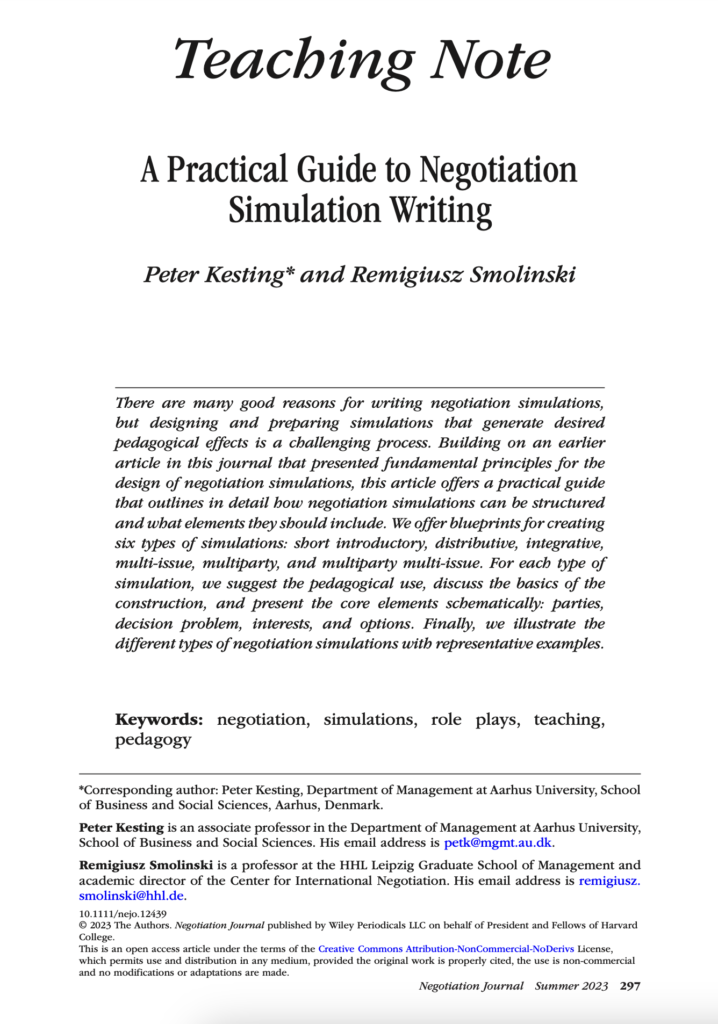
A Practical Guide to Negotiation Simulation Writing

Delighted to share that our paper: A Practical Guide to Negotiation Simulation Writing is available in open access on the website of Harvard’s Negotiation Journal!

Running negotiation competitions for students and professionals requires producing new negotiation simulations. Over the years, we’ve designed, written, tested, and assessed hundreds of negotiation simulations and our paper shares the lessons we’ve learned along the way. It includes also a step-by-step practical guide how to write effective negotiation simulations.

Many thanks to my partner in crime Peter Kesting for this excellent idea and Silvia P. Glick, Melissa Manwaring and other anonymous reviewers for their suggestions and feedback.

We are super excited and couldn’t wait to share it with you and look forward to receiving your feedback!

Source: A Practical Guide to Negotiation Simulation Writing – Kesting – 2023 – Negotiation Journal – Wiley Online Library

The Negotiation Challenge for Professionals

Negotiation is an art we all practice, whether we realize it or not. It permeates various aspects of our lives, from deciding where to eat with friends to securing business deals that impact our economic well-being. Some of us even negotiate professionally, making negotiation skills a crucial asset for success in our careers. Given its ubiquity and significance, it becomes vital to introspect and ask ourselves: Are we good negotiators? Can we negotiate effectively when it truly matters?

As founders of one of the first international negotiation competitions, The Negotiation Challenge, we once struggled to pinpoint the exact factors contributing to negotiators’ performance. The journey began with intuition, but we knew we needed more. Over time, we crafted a comprehensive evaluation system grounded in solid academic research, which has since proven to be a reliable benchmark for assessing and comparing negotiators’ abilities.

Throughout human history, we have relentlessly pursued mastery and excellence in various fields. Whether it’s determining the fastest runner, the strongest warrior, or the most skilled musician, competitions have been our means of comparison and a catalyst for greatness. In the spirit of this quest, we established The Negotiation Challenge for Professionals, a fair and transparent competition designed to put your negotiation skills to the test and measure them against others in your domain.

No matter your professional background—be it sales, procurement, entrepreneurship, M&A advisory, strategy consulting, or legal practice—The Negotiation Challenge invites you to participate and systematically assess your negotiation prowess alongside passionate negotiators from diverse countries and cultures.

Why should you seize this unique opportunity to develop your negotiation skills?

  1. Negotiate with the Best – The Negotiation Challenge attracts top-notch negotiators from around the world. Facing off against them demands the utilization of a wide array of negotiation tools and methods to engineer value and strike astute agreements. This challenge is your gateway to becoming an even better negotiator.
  2. Network with Passionate Negotiators – Engaging in The Negotiation Challenge allows you to connect with fellow passionate negotiators from various companies and nations. Through these interactions, you can exchange experiences, broaden your network, and learn from different perspectives.
  3. Feedback from Negotiation Experts – The founders and judges of The Negotiation Challenge are not just thought leaders and experts in the field; they are seasoned negotiators themselves. Their invaluable feedback has helped countless participants diagnose weaknesses and optimize their negotiation styles for success.
  4. Develop Your Negotiation Skills – Confronted with intricate negotiation scenarios and competing against well-trained and experienced counterparts, participants receive an excellent opportunity to elevate their negotiation skills. The guidance and coaching provided by judges further aid in their development.

The ability to navigate conflicts and negotiate wise agreements profoundly impacts the quality of our lives. Whether you are a seasoned negotiator or aspire to hone your negotiation craft, we extend our invitation to join The Negotiation Challenge. Together, we will shape a world where effective negotiation becomes a cornerstone of personal and professional success.

Unlock your negotiation potential and register for The Negotiation Challenge today! Embrace the opportunity to excel, grow, and become an extraordinary negotiator.

What Does It Mean To Negotiate Well?

What does it mean to negotiate well and what is the panda bear effect?

In our chat with Kwame Christian from American Negotiation Institute, we talk about a topic that has been very important to me ever since we’ve launched our negotiation competition, The Negotiation Challenge. It is quite surprising that after four decades of research, we still do not have widely recognized standards for evaluating negotiators’ performance. This was mainly the reason behind our work on the Negotiation Competency Model.

While organizing and judging various negotiation competitions, we’ve also observed that the teams that usually do well display something, we called the panda bear effect. To find out what it is, tune in to our episode of Negotiate Anything!

https://play.acast.com/s/07e56094-8598-4d02-b073-738fdf0ae3fb/879c5894-1eff-11ed-8642-df41cc5e35b1

In Search of Master Negotiators: A Negotiation Competency Model (PDF)

This paper systematically derives and summarizes the evaluation criteria we use in our international negotiation competitions for students and professionals. They are based on a systematic literature review connecting observable negotiation behavior with their impact on negotiation outcomes and summarized in a negotiation competency model. The model includes a set of selected negotiation competencies together with proficiency levels and their behavioral indicators. Our goal is to help scholars design more effective negotiation courses and fairer negotiation competitions, improve negotiation pedagogy, and train negotiators who are well prepared to handle conflicts in our increasingly complex society.

Source: (PDF) In Search of Master Negotiators: A Negotiation Competency Model