What if the next major leap in negotiation science didn’t come solely from artificial intelligence but from quantum mechanics?
I’m excited to share a new line of research that reflects how rapidly our understanding of negotiation technologies is evolving, and how unexpected scientific domains may soon shape the future of our field.
From AI to Quantum Thinking in Negotiation
For many years, my work has focused on negotiation and innovation. With the founding of Discurso.AI, we have explored how artificial intelligence can transform negotiation processes, supporting decision-making, enhancing outcomes, and scaling human capabilities. That journey has been both challenging and deeply rewarding.
Recently, however, together with my colleagues Marek Szopa and Piotr Frąckiewicz, I began asking a different question: What happens if we rethink negotiation using the principles of quantum mechanics?
The answer, it turns out, opens up an entirely new frontier, which we started exploring in our paper:
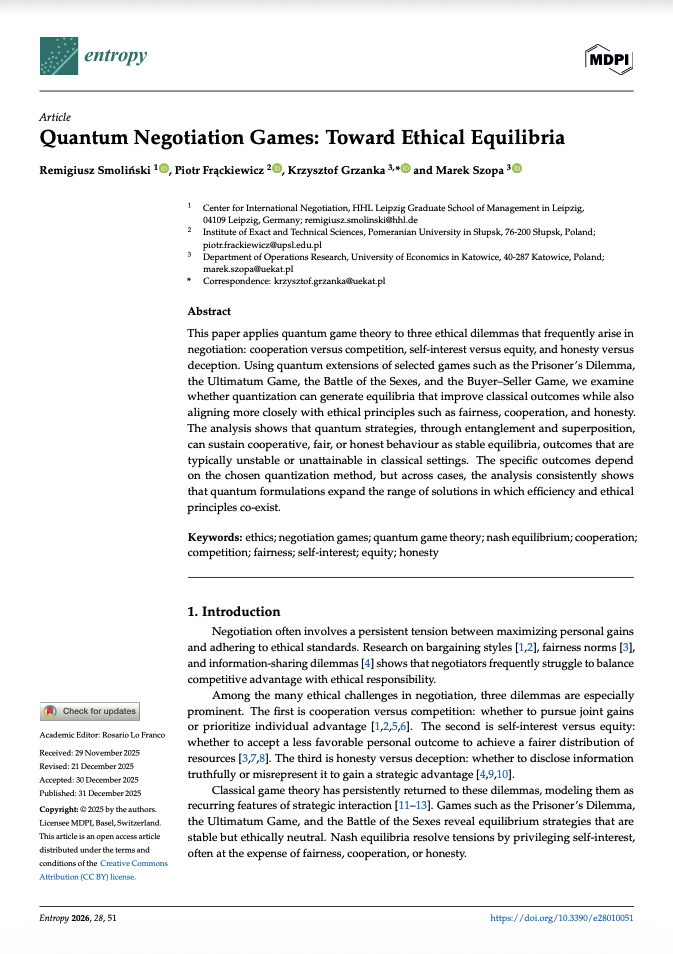
Smoliński, R., Frąckiewicz, P., Grzanka, K., & Szopa, M. (2026). Quantum Negotiation Games: Toward Ethical Equilibria. Entropy, 28(1), 51. https://doi.org/10.3390/e28010051.
The Limits of Classical Negotiation Models
Traditional negotiation theory, largely grounded in classical game theory, often assumes a difficult trade-off between rational self-interest and ethical outcomes such as fairness, cooperation, or honesty. Canonical solutions like Nash equilibria tend to prioritize efficiency, sometimes at the cost of these ethical norms.
As a result, many negotiation support systems struggle with a fundamental limitation: ethical behavior is frequently unstable, fragile, or dependent on external enforcement mechanisms.
Enter Quantum Game Theory
Our new research applies quantum game theory to core negotiation dilemmas, including:
- Cooperation vs. competition
- Self-interest vs. equity
- Honesty vs. deception
By introducing quantum strategies, based on concepts such as superposition and entanglement, we expand the strategic landscape beyond what classical mixed strategies allow.
This expanded space produces striking results.
What Changes in a Quantum Negotiation Framework?
Across quantum versions of classic games, such as the Prisoner’s Dilemma, Ultimatum Game, Battle of the Sexes, and Buyer–Seller Game, we observe several consistent patterns:
- Entanglement enables implicit coordination, even without communication.
- Superposition broadens strategic choice, allowing negotiators to move beyond rigid either–or decisions.
- Ethical outcomes become stable equilibria, not rare exceptions. Cooperation, fairness, and truth-telling can persist without external enforcement.
In short, quantum strategies can reconcile rational self-interest with ethical principles—not by constraining behavior, but by fundamentally enlarging what is strategically possible.
Implications for the Future of Negotiation Systems
These findings suggest a path toward next-generation negotiation support systems, systems that go beyond classical AI by designing strategic environments where ethical behavior naturally emerges as an equilibrium.
While fully mature quantum hardware is still on the horizon, quantum-inspired algorithms may arrive much sooner. These approaches could enhance:
- Multi-agent negotiation platforms
- Automated and smart contracts
- Decentralized governance mechanisms
- Decision systems where legitimacy, trust, and equity are essential
Looking Ahead
The full paper is available in open access, and we warmly invite feedback, critique, and discussion. This work is only a first step, but one that suggests negotiation science may be on the brink of a profound conceptual shift.
Happy New Year, Negotiators!
Source: Quantum Negotiation Games: Toward Ethical Equilibria | MDPI