Does emotional intelligence make someone a better negotiator?
The intuitive answer seems obvious. Negotiators who understand emotions, regulate their own reactions, empathize with others, and communicate skillfully should achieve better outcomes. The scientific answer, however, is more nuanced.
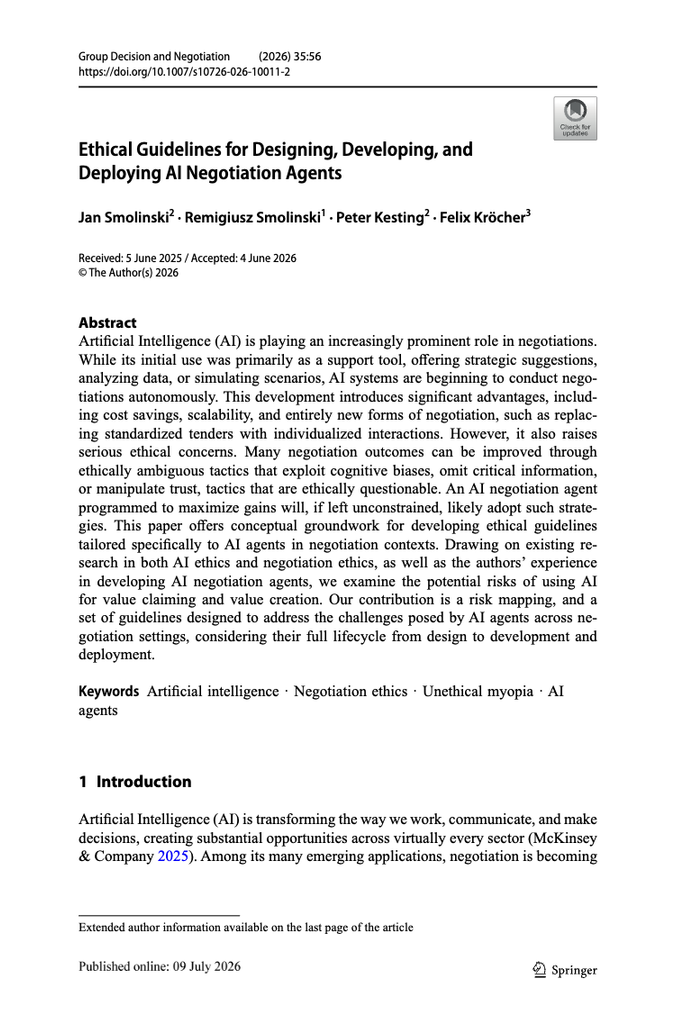
Our new article, “Emotional Intelligence in Negotiation: A Systematic Overview and Meta Analysis,” co-authored with Christoph Streer, has now been published open access in Negotiation and Conflict Management Research.
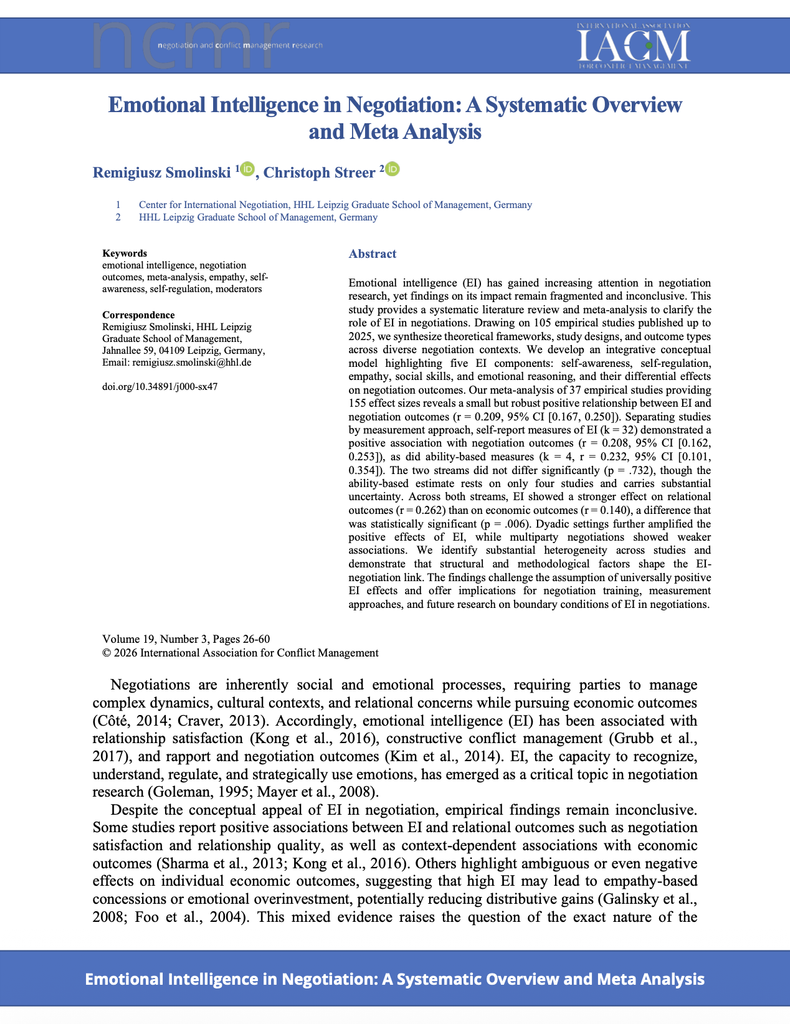
The article brings together the fragmented research on emotional intelligence and negotiation and addresses a deceptively simple question: To what extent and under what conditions does emotional intelligence actually improve negotiation outcomes?
The intuitive appeal of emotional intelligence
Negotiation is an inherently social and emotional process. Negotiators experience anxiety, frustration, disappointment, excitement, anger, and uncertainty. They interpret what the other side says and how it is said. They must decide whether an emotional reaction is authentic, strategic, or perhaps both.
It therefore seems reasonable to assume that emotionally intelligent negotiators should perform better. They may be more capable of recognizing the other side’s concerns, regulating their own impulses, communicating constructively, building trust, and maintaining productive relationships. They may also be better at noticing subtle signals, adapting their approach, and preventing difficult conversations from escalating.
Yet the empirical evidence has not always supported such a straightforward conclusion. Some studies associate emotional intelligence with trust, rapport, satisfaction, and negotiation effectiveness. Others find only weak relationships with economic outcomes. Some even suggest that empathy, emotional sensitivity, or intensive emotion regulation can reduce a negotiator’s individual gains under certain conditions.
In other words, emotional intelligence may help, but what it helps with, and when, matters enormously.
Bringing together a fragmented field
To clarify the evidence, we conducted a systematic review of 105 empirical studies published up to June 2025. These studies approach emotional intelligence in very different ways. Some treat it as an ability that can be assessed through performance-based tests. Others measure it through self-reports. Still others focus on individual components or related capacities, such as empathy, emotional awareness, emotion recognition, or self-regulation.
The studies also examine very different types of negotiations, including buyer–seller simulations, employment and sales negotiations, legal and intercultural contexts, multiparty negotiations, and professional conflict-resolution settings.
From this broader body of research, we identified 37 studies providing 155 effect sizes that could be included in a quantitative meta-analysis. This allowed us to move beyond individual findings and estimate the overall relationship between emotional intelligence and negotiation outcomes.
Emotional intelligence helps but the overall effect is modest
The meta-analysis reveals a small but robust positive relationship between emotional intelligence and negotiation outcomes overall. The estimated relationship was:
r = 0.209
This means that emotional intelligence does matter. However, it is not a universal or dominant predictor of negotiation success. It should therefore not be treated as a magical capability that automatically produces superior agreements. Negotiation performance remains influenced by many other factors, including preparation, alternatives, power, strategic judgment, experience, cultural context, incentives, and the structure of the negotiation itself. More importantly, the overall effect conceals a critical distinction.
Emotional intelligence improves relationships more than economic outcomes
The clearest finding of our study is that emotional intelligence is considerably more strongly related to relational outcomes than to economic outcomes. For relational outcomes, including trust, rapport, communication quality, satisfaction, and relationship quality, the relationship was:
r = 0.262
For economic outcomes, including individual gain, joint value, and efficiency, it was:
r = 0.140
The difference was statistically significant. This distinction is central to understanding what emotional intelligence can realistically contribute to negotiation.
Emotionally intelligent negotiators appear particularly well equipped to manage the interaction. They may create a more constructive atmosphere, understand the other party’s concerns, communicate more effectively, and develop stronger relationships. These capabilities are valuable. In many negotiations, especially those involving repeated interaction, implementation, teamwork, or long-term cooperation, relational quality is not secondary to the agreement. It is part of the agreement’s value.
However, understanding the other side’s emotions does not automatically mean claiming more value, securing a better price, or reaching a more economically efficient deal. A negotiator can conduct an excellent conversation and still leave money on the table.
The emotional intelligence paradox
The findings help explain what might be described as an emotional intelligence paradox. Many of the qualities associated with emotional intelligence: empathy, sensitivity, responsiveness, and concern for the relationship, can support value creation. They help negotiators exchange information, understand underlying interests, identify trade-offs, and maintain cooperation.
The same qualities, however, may sometimes make value claiming more difficult. A highly empathetic negotiator may become too accommodating. A negotiator who is very responsive to the counterpart’s disappointment may concede unnecessarily. Someone focused on preserving harmony may avoid the tension that is sometimes required to defend legitimate interests. In competitive or distributive situations, emotional sensitivity can therefore become both an asset and a liability.
Our review identified several conditions under which higher emotional intelligence was associated with weaker individual economic outcomes. These included competitive bargaining, power asymmetries, intercultural mismatches, and emotionally demanding situations in which regulation consumed cognitive resources.
This does not mean that empathy or emotional regulation is undesirable. It means that these capabilities must be combined with assertiveness, strategic discipline, and a clear understanding of one’s objectives and alternatives.
Context matters
The structure of the negotiation also appears to shape the value of emotional intelligence. The positive effects were stronger in dyadic negotiations, involving two parties, than in multiparty or group settings.
A two-party negotiation may give negotiators more opportunity to read emotional signals, adapt their behavior, develop rapport, and respond directly to the counterpart. Individual accountability is also clearer.
In multiparty negotiations, emotional dynamics become more complex. Negotiators must interpret multiple people, coalitions may emerge, interests become harder to map, and an emotionally intelligent response to one person may have unintended effects on others.
The lesson is not that emotional intelligence becomes irrelevant in groups. Rather, the way it operates may be different, and the evidence for its benefits is less consistent.
Emotional intelligence is not a single capability
Our article also proposes an integrative model distinguishing five components of emotional intelligence that are particularly relevant to negotiation: self-awareness, self-regulation, empathy, social skills, emotional reasoning. These components should not be assumed to have identical effects.
Self-awareness may help negotiators recognize when fear, anger, or overconfidence is influencing their judgment. Self-regulation may help them remain composed under pressure. Empathy can support perspective-taking and the discovery of interests. Social skills facilitate communication and relationship management. Emotional reasoning helps negotiators interpret emotional information in light of their strategic goals.
A negotiator may be strong in one component and weak in another. Someone may recognize emotions accurately but respond to them poorly. Another person may regulate emotions effectively but fail to understand what the other side is experiencing. Treating emotional intelligence as one global score can conceal these important differences.
What this means for negotiation training
The findings support the inclusion of emotional competencies in negotiation education and development. Negotiators can benefit from learning to recognize emotional triggers, regulate their reactions, listen more accurately, interpret emotional signals, and understand the relationship between emotion and decision-making. Simulations, behavioral feedback, coaching, reflection, and structured debriefing may all help develop these capabilities.
However, emotional intelligence training should not be presented as a substitute for other negotiation competencies. It should complement training in preparation, analytical judgment, value creation, value claiming, communication, ethics, and strategic decision-making.
A well-rounded negotiator needs to understand emotions without becoming governed by them. Negotiators should be capable of showing empathy while protecting their interests, building relationships while maintaining boundaries, and regulating emotions without suppressing information that may be strategically important. The objective is not simply to become more emotionally responsive. It is to use emotional information intelligently.
A more realistic understanding of emotional intelligence
Our study challenges two opposing simplifications. The first is that emotional intelligence is a universal route to better negotiation performance. The second is that emotions are merely distractions from rational negotiation. Neither view is supported by the evidence.
Emotional intelligence is a meaningful negotiation capability, but its effects are conditional. It contributes most consistently to trust, rapport, communication, and relationship quality. Its influence on economic outcomes is smaller, and in some settings emotional responsiveness may even reduce individual gains. The real question is therefore:
Which emotional capability matters, for which outcome, in which type of negotiation, and under which conditions?
Answering these questions will require future research that distinguishes specific emotional competencies, accounts more carefully for the interdependence between negotiators, and examines professional negotiations beyond laboratory and classroom settings.
Negotiation excellence requires more than emotional intelligence
Good negotiators cannot be selective in the competencies they develop.
They cannot rely on empathy while neglecting analysis. They cannot pursue economic value while damaging relationships, communicate persuasively while ignoring ethical responsibility, or prepare rigorously without being able to adapt when the negotiation takes an unexpected turn.
This is precisely the premise of the Negotiation Competency Model that Yun Xiong and I introduced in our article In Search of Master Negotiators: A Negotiation Competency Model. The model brings together four interdependent areas: language and emotionality, negotiation intelligence, relationship building, and moral wisdom.
From this perspective, emotional intelligence is an essential component of a much broader competency architecture. Recognizing emotions has limited value without the analytical ability to understand the negotiation. Empathy may support cooperation, but it must be balanced with assertiveness and strategic discipline. Relationship building matters, but it cannot replace sound judgment about interests, alternatives, value creation, and value claiming. And none of these capabilities should be separated from the ethical responsibility that accompanies their use.
The best negotiators are therefore not those who feel the most, calculate the best, or claim the most value in isolation. They are those who integrate these capabilities: reading emotions without being ruled by them, building relationships without surrendering legitimate interests, pursuing strong outcomes without compromising ethical judgment, and adjusting their behavior to the demands of the situation.
Our findings reinforce this holistic understanding of negotiation performance. Emotional intelligence can make an important contribution, particularly to trust, communication, satisfaction, and relationship quality. But negotiation mastery begins where selective competence ends.
A great negotiator knows the full repertoire of negotiation competencies, has a strong command of them, and understands when, how, and in what combination to use them.
The full article is available open access: