Emotional intelligence is widely regarded as one of the characteristics of an effective negotiator. The logic seems compelling. Negotiators who recognize emotions, regulate their reactions, empathize with others, and communicate sensitively should be better equipped to build trust, exchange information, resolve tensions, and reach good agreements.
But what if some of these strengths also create vulnerabilities? What if empathy encourages excessive accommodation? What if preserving harmony makes it harder to defend legitimate interests? And what if a negotiator who is highly sensitive to emotions becomes more susceptible to a counterpart who uses anger, disappointment, or enthusiasm strategically?
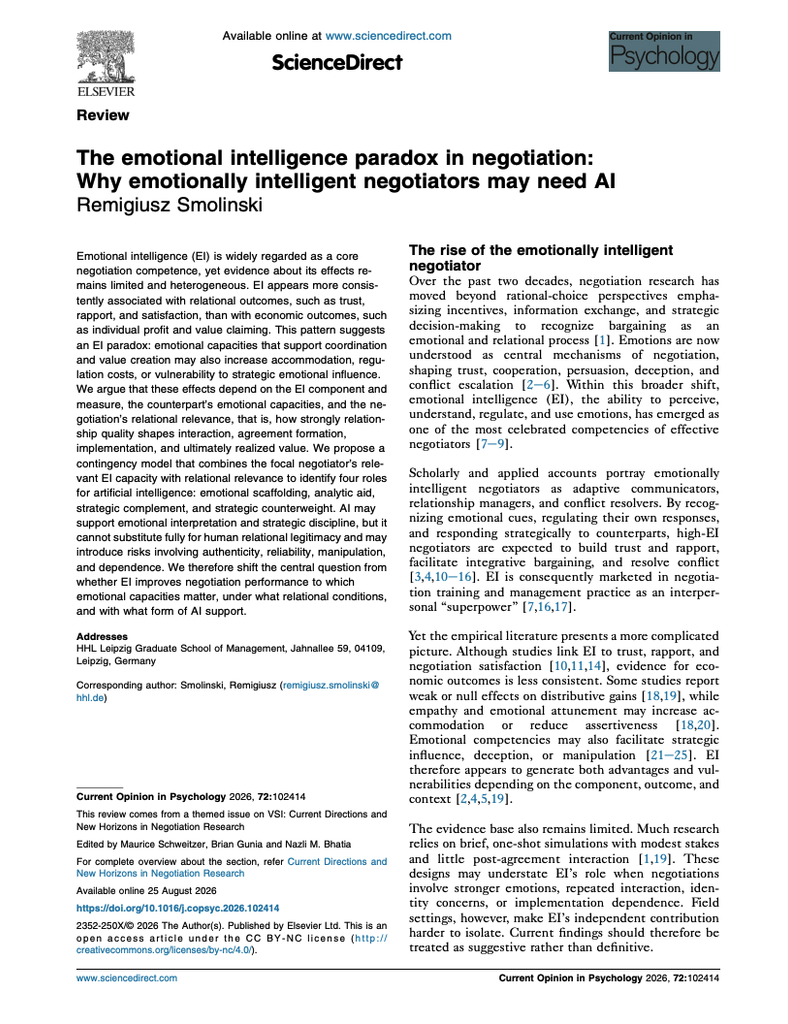
These questions are at the center of my article, “The Emotional Intelligence Paradox in Negotiation: Why Emotionally Intelligent Negotiators May Need AI,” in Current Opinion in Psychology.
Emotional intelligence helps, but not always in the way we expect
In an earlier systematic review and meta-analysis conducted with Christoph Streer, we examined 105 empirical studies on emotional intelligence in negotiation. Of these, 37 studies providing 155 effect sizes could be included in the quantitative analysis.
The results showed a small but robust positive relationship between emotional intelligence and negotiation outcomes. More importantly, however, emotional intelligence was considerably more strongly associated with relational outcomes, such as trust, rapport, satisfaction, and relationship quality, than with economic outcomes, such as individual profit, joint value, and efficiency.
This distinction matters. An emotionally intelligent negotiator may create a constructive atmosphere, understand the other party’s concerns, and make the counterpart feel respected. Yet none of this automatically guarantees a better price, a larger share of the value, or a more efficient agreement. A negotiation can feel excellent while still producing a disappointing substantive result.
The emotional intelligence paradox
Emotional intelligence supports several processes that are essential to successful negotiation. It can help negotiators: recognize emotional signals, regulate frustration and anxiety, understand the other party’s perspective, communicate difficult messages constructively, create trust and psychological safety, identify concerns that have not been expressed directly.
These capabilities can improve coordination and support value creation. But some of them may also make value claiming more difficult. A highly empathetic negotiator may understand the other side’s constraints so well that they begin to accept them as their own. Someone who is sensitive to disappointment may make concessions simply to reduce interpersonal tension. A negotiator focused on preserving the relationship may hesitate to set boundaries or challenge an unreasonable demand.
Emotion regulation can also be cognitively demanding. Suppressing anger, managing anxiety, and monitoring the counterpart’s reactions all consume attention that might otherwise be used to evaluate offers or develop strategy.
Finally, emotional intelligence does not operate in isolation. The counterpart may also be emotionally skilled and may use that ability cooperatively or strategically. A negotiator who accurately reads emotions may create value, while an equally perceptive counterpart captures most of it.
This is the paradox: the same emotional capacities that make cooperation possible may also expose a negotiator to accommodation, cognitive overload, or strategic emotional influence.
Emotional intelligence is not one general ability
Asking whether someone “has emotional intelligence” is too broad to be particularly useful. Negotiation may require several distinct emotional capacities, including self-awareness, self-regulation, empathy, social skills, emotion recognition, and emotional reasoning. A negotiator may be strong in some of these areas and weaker in others.
Someone may recognize emotions accurately but struggle to respond effectively. Another person may remain calm under pressure but misinterpret what the counterpart is feeling. A third may show considerable empathy while lacking the assertiveness required to protect their interests.
The relevant aspect is therefore not negotiators’ high overall emotional-intelligence score, but whether they possess the particular emotional capacity required by the situation. and this is where artificial intelligence may become useful.
Relational relevance: how much does the relationship matter?
My article introduces relational relevance as a central contingency for deciding how emotional intelligence and AI should be combined. Relational relevance describes how strongly the quality of the relationship affects the negotiation process, the formation and implementation of the agreement, and the value ultimately created.
Relational relevance is typically high when parties expect to work together in the future, depend on one another during implementation, or require mutual trust to exchange sensitive information. Examples may include strategic partnerships, leadership negotiations, employment relationships, family businesses, diplomacy, and long-term supplier relationships.
It is lower in relatively standardized, one-off transactions in which the agreement can be specified and enforced without extensive future cooperation. This distinction implies that the importance of relationships varies and so does the value of emotional intelligence.
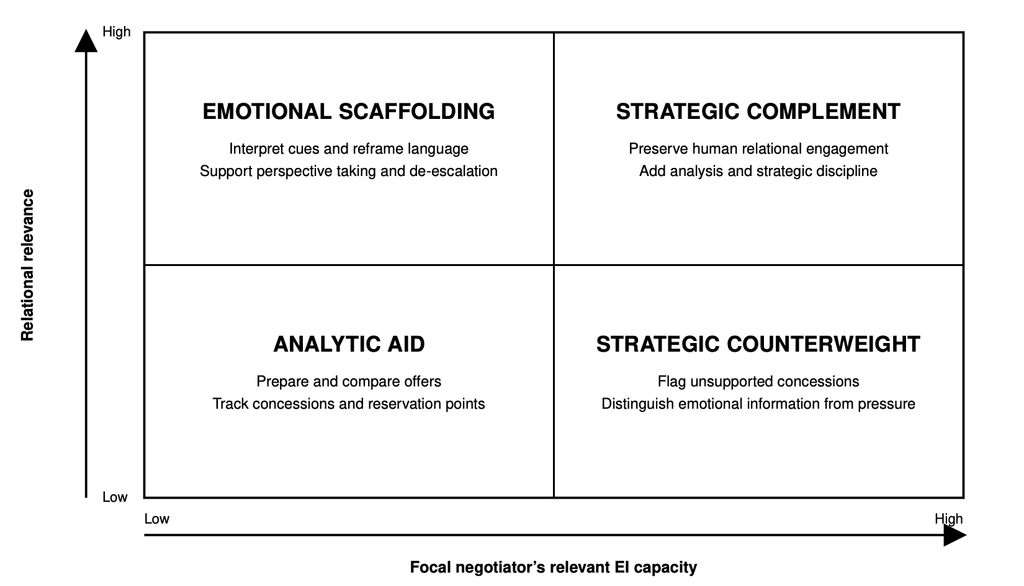
By combining relational relevance with the negotiator’s relevant emotional capacity, we can identify four different roles for AI.
Four roles for AI in negotiation
Figure 1 brings these considerations together in a contingency model. The horizontal axis represents the focal negotiator’s relevant emotional-intelligence capacity, while the vertical axis captures relational relevance: the extent to which relationship quality influences the interaction, agreement formation, implementation, and ultimately realized value. The four quadrants identify AI’s proposed primary role under different combinations of these conditions. They should be understood as contingent tendencies that guide judgment, not as fixed prescriptions.
1. Emotional scaffolding
When relational relevance is high but the negotiator’s relevant emotional capacity is limited, AI can provide emotional scaffolding.
Before a difficult conversation, it might help the negotiator consider alternative interpretations of the counterpart’s behavior, anticipate emotional triggers, formulate constructive questions, or rehearse different ways of delivering a sensitive message.
AI should not take ownership of the relationship. It can, however, help the human negotiator enter the conversation with greater awareness and a broader range of possible responses.
2. Analytic aid
When both relational relevance and the need for advanced emotional capabilities are relatively low, AI can serve primarily as an analytic aid.
It can help clarify interests, calculate reservation values, compare offers, identify trade-offs, test alternative packages, and monitor the developing concession pattern.
In such settings, AI’s greatest contribution may be discipline and computational support rather than emotional interpretation.
3. Strategic complement
When relational relevance is high and the negotiator already possesses strong emotional capacities, AI can operate as a backstage strategic complement.
The human negotiator can focus on dialogue, trust, legitimacy, and the nuances of the relationship. Meanwhile, AI can compare packages, preserve records, monitor concessions, identify inconsistencies, and test whether emerging agreements satisfy the negotiator’s substantive objectives.
The purpose is not to replace emotional intelligence but to complement it with analytical precision.
4. Strategic counterweight
When relational relevance is comparatively low but the negotiator has strong emotional capacities, AI may serve as a strategic counterweight.
Its role is to prevent emotional responsiveness from becoming unnecessary accommodation. AI might flag when concessions are moving beyond prepared limits, remind the negotiator of their alternatives, distinguish understanding from agreement, or test whether concern for the counterpart is distorting the evaluation of an offer.
Empathy remains valuable, but empathy does not require surrendering legitimate interests.
AI does not remove the need for human judgment
It would be a mistake to conclude that AI can simply correct the limitations of human emotional intelligence. AI can misinterpret emotional cues, generate unreliable advice, reinforce questionable assumptions, or create unjustified confidence in its analysis. Its use may also raise concerns about confidentiality, authenticity, transparency, and manipulation.
Overreliance creates another risk. Negotiators who repeatedly delegate emotional interpretation or strategic judgment may gradually weaken the very capabilities that AI is supposed to support.
Most importantly, AI cannot fully reproduce human relational legitimacy. A carefully generated empathetic response is not necessarily experienced in the same way as genuine human concern. Trust depends not only on the words used but also on who accepts responsibility for them.
AI can support the relationship, but it cannot own it.
Toward the augmented negotiator
The most promising future is therefore neither purely human nor fully automated. AI can help negotiators prepare more systematically, examine alternative interpretations, preserve strategic discipline, and notice when empathy begins to turn into over-accommodation. Human negotiators remain responsible for judgment, accountability, ethical boundaries, and the quality of the relationship.
Before using AI in a negotiation, it may therefore be useful to ask:
- How important is the relationship to reaching and implementing this agreement?
- Which emotional capacity does this situation require?
- Where am I most vulnerable: emotional misreading, escalation, accommodation, or analytical drift?
- What specific and bounded role should AI play?
- Which decisions must remain visibly and meaningfully human?
The objective of this analysis is to combine emotional and analytical capabilities in a way that fits the situation.
When emotional intelligence needs a counterweight
Emotional intelligence helps negotiators notice anxiety, frustration, hope, and disappointment. But reading emotions accurately does not guarantee sound judgment. In the heat of a negotiation, the ability to feel with the counterpart can quietly blur the boundary between understanding their position and giving in to it.
This may be AI’s most valuable role: not speaking for us or manufacturing artificial empathy, but protecting strategic clarity in the background. It can track concessions, test alternatives, challenge assumptions, and remind us of our objectives while we remain fully present in the human interaction.
The future of negotiation will belong neither to unemotional algorithms nor to humans guided by intuition alone. It will belong to negotiators who know how to combine relational judgment with analytical discipline, and when not to outsource either.
Emotional intelligence helps us read the room. AI may help us make the most of what we find there.
The full article is available here:
Smolinski, R. (2026). “The Emotional Intelligence Paradox in Negotiation: Why Emotionally Intelligent Negotiators May Need AI.” Current Opinion in Psychology.
Source: The Emotional Intelligence Paradox in Negotiation: Why Emotionally Intelligent Negotiators May Need AI| Current Opinion in Psychology.