Much of negotiation theory and practice is organized around a simple idea: better negotiators achieve better outcomes, and better outcomes usually mean more. We encourage negotiators to set ambitious targets, make strong first offers, create as much value as possible, and claim a substantial share of it. When value remains on the table, we tend to interpret it as evidence of poor preparation, limited skill, cognitive bias, or strategic failure.
These ideas have transformed negotiation teaching and practice, and they remain enormously valuable. But they also rest on an assumption that is rarely questioned: if more value can still be obtained, a rational negotiator should continue pursuing it. Is that always true?
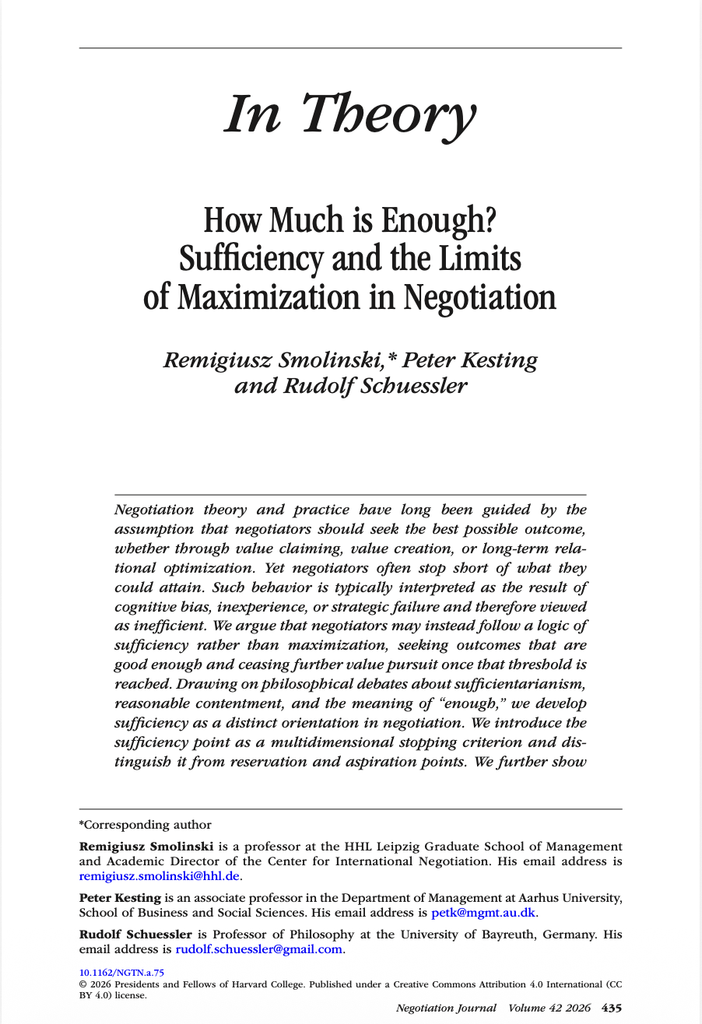
In our newly published article, “How Much Is Enough? Sufficiency and the Limits of Maximization in Negotiation,” co-authored with Peter Kesting and Rudolf Schüssler, we explore an alternative possibility. Negotiators may sometimes stop not because they are unable to obtain more, but because they have reached a point at which more is no longer necessary, proportionate, or worth pursuing. We call this the logic of sufficiency.
When “more” becomes the definition of success
The ideal of maximization is deeply embedded in the language of negotiation. In distributive negotiation, success means claiming the largest possible share of a fixed amount of value. In integrative negotiation, it means expanding the pie and reaching a Pareto-efficient agreement. Even in long-term relationships, the objective is often described as maximizing value over time.
The object being maximized may change, but the underlying logic remains the same: as long as an improvement is possible, stopping appears irrational.
Our article opens with an image from Robert Harris’s Imperium: Pompey the Great displaying a fish adorned with jewels, a symbol of abundance that has become detached from need, utility, or meaning. It captures what we describe as maximization without measure. More is pursued because it is more, rather than because it still serves a meaningful purpose.

Negotiation can follow the same logic. A negotiator may continue pressing for a lower price, an additional concession, or a slightly more favorable clause long after the resulting gain has ceased to matter. The agreement may look better on a spreadsheet, yet be worse when we consider the time consumed, the resentment created, the burden placed on implementation, or the effect on people who were not present at the table.
Maximization is therefore not self-justifying. Before asking whether more can be obtained, we may also need to ask what that additional value is for.
The sufficiency point
At the center of our argument is the concept of a sufficiency point: the point at which a negotiator judges that an outcome adequately fulfills their legitimate objectives and that further gains are no longer necessary or worth pursuing.
Negotiators are already taught to prepare two important reference points: the reservation point marks the boundary below which an agreement should be rejected and the aspiration point represents the ambitious outcome the negotiator hopes to achieve. The sufficiency point answers a different question: At what point would the outcome genuinely be enough?
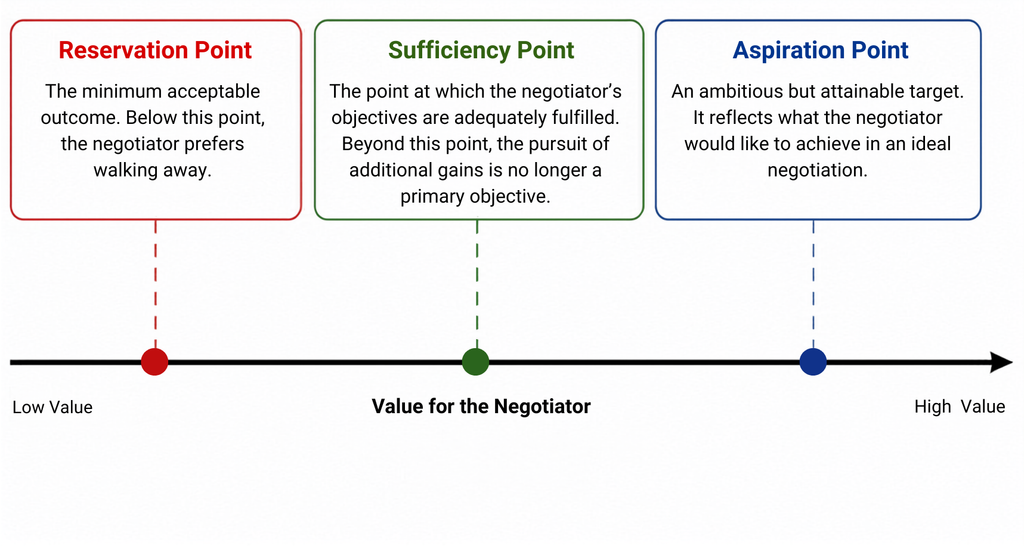
A reservation point and an aspiration point are usually expressed on the value scale of the negotiation: a price, salary, percentage, delivery date, or package score. Sufficiency is a higher-order judgment. It may include economic needs, but also fairness, relationships, moral commitments, stakeholder effects, implementation risks, sustainability, and the broader circumstances in which the agreement will operate.
The sufficiency point is therefore often multidimensional. A manager may regard an agreement as sufficient only if it protects the company’s economic interests, treats employees responsibly, preserves a strategically important supplier relationship, and remains defensible to shareholders. A salary package may be sufficient not because it contains the maximum available salary, but because it combines adequate pay with autonomy, meaningful work, reasonable demands, and long-term opportunity. In both cases, “enough” cannot be reduced to a single number.
Sufficiency is not satisficing
The idea of accepting an outcome that is “good enough” may sound similar to Herbert Simon’s concept of satisficing, but the distinction is important. Satisficing is primarily a response to bounded rationality. Because information, time, and cognitive capacity are limited, decision-makers stop searching once they encounter an acceptable option. Continuing the search might produce something better, but the expected improvement no longer justifies the additional effort or cost.
Sufficiency can lead to the same observable behavior: stopping before the maximum, but for a different reason. The negotiator may know that more value is available and may even be able to obtain it easily. They nevertheless decide not to pursue it because the present outcome is enough. This decision reflects a judgment about the value, purpose, and proportionality of further gain.
Sufficiency is not the same as compromise or splitting the difference. Compromise describes one way of resolving conflicting positions. Sufficiency is a stopping rule. It can support a distributive agreement, a compromise, or a highly creative integrative solution. What matters is not the form of the agreement, but why the negotiator decides that there is no need to keep extracting more.
When leaving value on the table is not a failure
Few expressions in negotiation carry as much criticism as “leaving value on the table.” It suggests that the negotiators failed to discover a trade-off, claimed too little, or settled prematurely. Sometimes that diagnosis is correct. Unexplored interests, weak preparation, or poor communication can certainly produce inferior agreements. But value left on the table is not always wasted value.
The film The Monk and the Gun provides a striking illustration. An American collector seeks to buy a rare rifle from a Bhutanese villager and is willing to pay far more than the villager ultimately accepts. From a conventional negotiation perspective, the villager has made a serious mistake. He could have claimed much more value and chose not to do so. From the perspective of sufficiency, however, the decision may be entirely coherent: the accepted amount was generous, adequate, and more appropriate to the villager’s understanding of what was needed.

The example is deliberately unsettling because it forces us to separate two questions that negotiation theory often treats as identical: Could the negotiator have obtained more? And should the negotiator have wanted more?
Residual value may also have uses beyond the focal negotiator. It may remain with employees, consumers, communities, suppliers, future partners, or society. A company that declines to extract every possible concession from a vulnerable supplier may preserve resilience and trust in its supply chain. A landlord who accepts a reasonable rent rather than the maximum the market will bear may help sustain a community. A party that refrains from exploiting temporary bargaining power may create the conditions for future cooperation.
Seen this way, apparent inefficiency can sometimes represent efficiency restraint: a deliberate decision not to exhaust every available gain because doing so would be unnecessary, disproportionate, or harmful when viewed through a broader frame.
Sufficiency can change the negotiation itself
Sufficiency may also change how negotiators behave before agreement is reached. If parties believe that every disclosed preference will be used to extract the maximum possible advantage, they have good reason to protect information and approach integrative moves with suspicion. By contrast, credible restraint may reduce fears of exploitation. It can make it safer to disclose interests, explore creative options, and build the trust on which value creation depends.
This does not mean that sufficiency automatically produces better relationships or more efficient agreements. Its effects are most likely conditional. A negotiator who encounters a fair and reasonable counterpart may be willing to stop once enough has been achieved. The same negotiator may respond very differently to someone who is aggressive, exploitative, or determined to capture every available gain. Sufficiency need not require unilateral generosity in the face of opportunism. Counterpart behavior can shift negotiators back toward maximization, just as deteriorating economic or security conditions can change what counts as enough. Sufficiency is therefore contextual and revisable.
Sufficiency is not an excuse to settle too early
There is an obvious danger in the language of “enough.” It could be used to rationalize poor preparation, weak ambition, avoidable concessions, or a premature agreement. It could also prevent parties from discovering integrative gains that would make everyone better off. That is not the argument we make.
Negotiators should still prepare carefully, understand their alternatives, set ambitious aspirations, exchange information, and search seriously for mutually beneficial trade-offs. Sufficiency should become relevant after genuine exploration, not serve as a reason to avoid it. Stopping before understanding what is possible may be complacency. Stopping after understanding what is possible can be judgment.
The distinction matters especially in integrative negotiation. Creating additional joint value is often beneficial because it need not come at the expense of either party. Yet even value creation has costs. Additional rounds of bargaining require time and attention; more complex packages can become difficult to understand and implement; and seemingly efficient options may shift costs to absent stakeholders. Pareto efficiency is valuable, but it is a form of rationality within a particular decision frame. It does not tell us whether that frame includes everything that ought to matter.
Preparing for enough
Therefore, the practical implication is that preparation should include another set of questions alongside the familiar analysis of interests, alternatives, and bargaining ranges:
- What do I genuinely need this agreement to accomplish?
- Which economic, relational, moral, or strategic objectives must it satisfy?
- Who else will bear the consequences of the agreement?
- At what point would additional gain cease to make a meaningful difference?
- What might be damaged by continuing to press for more?
- Under which circumstances should my judgment of “enough” change?
Answering these questions in advance can be difficult, but that is precisely why they belong in preparation. In the pressure of a negotiation, success is easily redefined by the next concession that might still be won. A sufficiency point provides a counterweight: not a rigid ceiling, but a reminder of the purposes the negotiation was meant to serve.
What this means for negotiation teaching
Negotiation education has become very good at teaching people how to get more. Students learn to diagnose the bargaining structure, calculate their alternatives, set ambitious targets, make and respond to offers, uncover interests, create value, and claim it effectively. These are essential competencies. But perhaps negotiation wisdom requires one more: knowing when further gain is no longer an improvement.
This changes the questions we ask when evaluating negotiation performance. Instead of looking only at how much value was created or claimed, we might also ask whether the outcome adequately met the parties’ legitimate objectives, whether further extraction would have served any meaningful purpose, and what consequences the agreement created outside the chosen scoring frame.
It also opens a broader research agenda. How do people form sufficiency points? How stable are they? How do power, culture, scarcity, identity, relationships, and counterpart behavior affect them? When does sufficiency support trust and sustainable cooperation, and when does it merely conceal low aspirations or unequal expectations? These are empirical questions, and we do not yet have all the answers.
A broader understanding of rationality
Our argument is not that maximization is wrong. In many negotiations, obtaining more is necessary, responsible, and entirely rational. Managers have obligations to their organizations and shareholders. Individuals may negotiate under conditions in which every additional resource matters. Innovation, exceptional performance, and ambitious social change often depend on refusing to settle for what currently appears sufficient. The problem begins when maximization stops being a means and becomes the unquestioned definition of success.
A negotiator who leaves value on the table may have miscalculated. But they may also have exercised restraint, protected a relationship, respected a moral commitment, accounted for stakeholders, or recognized that another increment of value would add little to a life, an organization, or a society that already has enough.
Rationality in negotiation should therefore involve more than choosing the best available outcome within a given frame. It should also involve judging whether the frame itself captures what matters. Negotiation expertise helps us obtain more. Negotiation wisdom may begin when we can explain why more is still worth having and recognize when it is not.
The full article is available here:
Smolinski, R., Kesting, P., & Schüssler, R. (2026). “How Much Is Enough? Sufficiency and the Limits of Maximization in Negotiation.” Negotiation Journal, 42, 435–457.
Source: How Much Is Enough? Sufficiency and the Limits of Maximization in Negotiation | Negotiation Journal